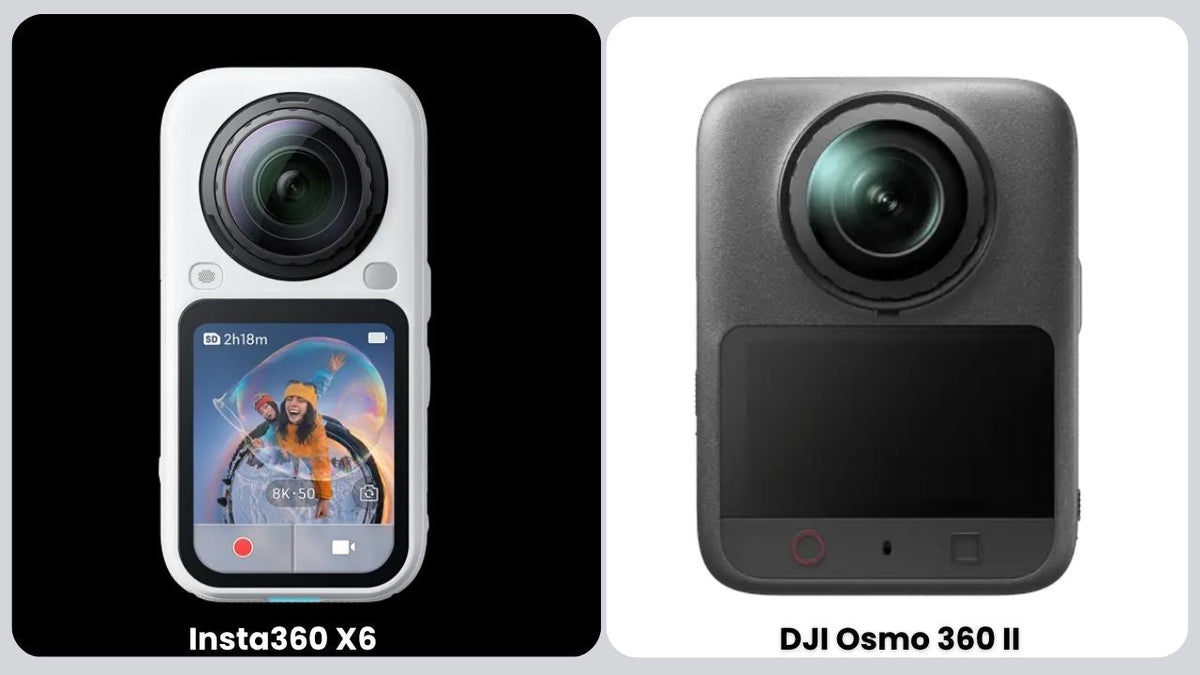
The DJI Osmo 360 II and Insta360 X6 are two flagship 8K 360 cameras built around a similar promise: record everything around you, then choose the best angle later. The difference is where each camera puts its strongest advantages.
The DJI Osmo 360 II is the better fit for buyers who prioritize native high-frame-rate 360 recording, generous internal storage, a lighter body, and compatibility with DJI’s Osmo ecosystem. The Insta360 X6 is the stronger choice for creators who want longer rated battery life, higher-resolution flat video, deeper waterproofing without a case, and more automated editing tools.
There is no universal winner. The right choice depends on whether you value more capture capability in the camera or a faster, more automated path from footage to a finished video.
Quick Answer
| Your priority | Better fit | Why |
|---|---|---|
| Native high-frame-rate 360 video | DJI Osmo 360 II | Up to 8K/60fps and native 4K/240fps panoramic slow motion |
| Ready-to-share flat video | Insta360 X6 | InstaFrame 2.0 can record direct 4K flat video, with an optional 8K 360 backup at supported frame rates |
| Single-lens action-camera use | Insta360 X6 | Up to 5K/60fps flat video; 170° is available at up to 5K/30fps |
| Internal storage | DJI Osmo 360 II | 105GB usable versus 47GB usable on X6 |
| Rated 8K/30fps battery life | Insta360 X6 | About 140 minutes versus DJI’s claim of up to 100 minutes, under different lab conditions |
| Waterproofing without a case | Insta360 X6 | 20 m (65.6 ft) versus 10 m (32.8 ft) |
| Lighter camera body | DJI Osmo 360 II | 183 g versus 196 g |
| Automated editing | Insta360 X6 | AI Director, Auto Edit 2.0, FlashCut, and an automation-heavy mobile/desktop workflow |
| Existing DJI accessories | DJI Osmo 360 II | Dual-direction quick release, 1/4-inch thread, OsmoAudio, and support for selected Osmo batteries |
The Most Important Similarity: “1-Inch 360 Imaging” Needs Context
Both cameras use dual 1/1.1-inch square CMOS sensors, and both companies describe the result as “1-inch 360 imaging.” That wording does not mean either camera contains two conventional rectangular 1-inch-type sensors.
DJI says each sensor uses an imaging area equivalent to a 1-inch 4:3 sensor when capturing 360 content. Insta360 makes a similar area-equivalence statement for the X6. The square design allows more of each sensor to contribute to the circular image produced by a fisheye lens.
In practical terms, both cameras begin with a large and efficient imaging platform for a compact 360 camera. Sensor labels alone, however, cannot tell us which produces better detail, stitching, noise reduction, color, or motion rendering. Those results also depend on the lens, exposure strategy, processor, bitrate, sharpening, and software pipeline.
DJI Osmo 360 II vs Insta360 X6 Specs
| Feature | DJI Osmo 360 II | Insta360 X6 |
| Sensors | Dual 1/1.1-inch square CMOS | Dual custom Sony 1/1.1-inch square CMOS |
| Aperture | f/1.9 | f/2.0 |
| Maximum standard 360 video | 8K/60fps | 8K/50fps |
| Standard 360 slow motion | 4K/240fps panoramic slow motion | 4K/100fps standard 360; separate Bullet Time modes reach 4K/240fps |
| Flat / single-lens video | Up to 4K/60fps standard; 4K/120fps Boost | Up to 5K/60fps; 4K/120fps |
| Direct tracked flat video | Spotlight Follow, export up to 4K/30fps | InstaFrame 2.0, direct 4K flat video; 8K 360 backup at up to 30fps |
| Color | 10-bit video; D-Log M in supported modes | 10-bit video; I-Log 10-bit in supported modes; Dolby Vision |
| Maximum 360 photo | 120MP HDR; JPEG and RAW | 120MP; INSP and DNG |
| Built-in storage | 128GB total, 105GB usable | 64GB total, 47GB usable |
| microSD support | Up to 1TB | Up to 1TB, UHS-I V30 or faster |
| Maximum video bitrate | 220 Mbps | 240 Mbps |
| Battery | 2,150 mAh | 2,600 mAh |
| Rated 8K/30fps runtime | Up to 100 minutes | About 140 minutes |
| Fast charge to 80% | About 22 minutes | About 24 minutes |
| Waterproof without case | 10 m / 32.8 ft | 20 m / 65.6 ft |
| With official dive case | 50 m / 164 ft | 60 m / 196.8 ft |
| Display | 2.0-inch touchscreen, 800 cd/m² | 2.32-inch OLED, up to 1,200 nits peak brightness |
| Weight | 183 g / 6.5 oz | 196 g / 6.9 oz |
| Replaceable lenses | Yes | Yes, Replaceable Lenses 2.0 |
Manufacturer runtime and dynamic-range figures are measured under different controlled conditions and should not be treated as direct laboratory comparisons. Recording temperature, airflow, screen use, wireless settings, firmware, and enabled features can change real-world results.
Image Quality: Too Close to Call From Specifications Alone
Both brands claim up to 14.5 stops of dynamic range, but those numbers are not automatically comparable. DJI specifies that its 14.5-stop figure was measured in 8K/30fps panoramic video using Normal color, auto exposure, and front-and-back metering; DJI lists up to 13.5 stops with D-Log M. Insta360 describes 14.5 stops as the X6’s maximum dynamic range without providing an identical cross-brand test method.
The same caution applies to low light. DJI combines an f/1.9 aperture with AI SuperNight 2.0, available in panoramic video up to 8K/60fps. Insta360 uses an f/2.0 aperture, dual ambient-light sensors, and PureVideo, which supports 360 recording up to 8K/30fps.
Early hands-on reports in our research were favorable toward the X6’s highlight retention, shadow detail, and low-light processing, but they were not controlled, independent tests conducted with identical settings. The responsible conclusion is therefore:
Both cameras have serious low-light hardware and dedicated night modes, but buyers should compare matched original footage before declaring an image-quality winner.
For creators who color-grade, both models offer 10-bit recording and a Log workflow. DJI’s D-Log M is useful if you already match footage across DJI cameras. Insta360’s I-Log 10-bit offers grading flexibility, while Dolby Vision provides an HDR delivery option for compatible displays. Availability varies by recording mode, so check the mode you intend to use.
Video Modes: DJI Wins 360 Frame Rates; X6 Wins Flat-Video Flexibility
The clearest DJI advantage is native high-frame-rate panoramic capture. Osmo 360 II records standard 360 video at up to 8K/60fps, compared with the X6’s 8K/50fps. DJI also records native 4K/240fps panoramic slow motion.
DJI Studio can use AI frame interpolation to turn 8K/60fps footage into motion described as equivalent to cropped 8K/480fps. That is a software-generated slow-motion result—not native 480fps capture—and should be understood as such.
The X6 answers with more flexible flat-video options. Its standard flat mode reaches 5K/60fps, although the maximum 170° field of view is available at up to 5K/30fps; 5K/60fps uses a narrower field of view of up to 132°. Both cameras can record 4K/120fps in their enhanced single-lens modes.
This distinction makes the buying decision easier:
-
Choose DJI when high-frame-rate 360 capture is the priority.
-
Choose X6 when the camera will frequently replace a conventional wide-angle action camera.
Reframing and Tracking: Two Different Approaches
DJI’s Spotlight Follow tracks a selected subject and exports a flat video at up to 4K/30fps through DJI Mimo or DJI Studio. DJI also provides auto-framing, intelligent tracking, speed-up tracking, and one-tap editing tools.
Insta360’s InstaFrame 2.0 can record a ready-to-share 4K flat video while preserving an 8K 360 backup at 24, 25, or 30fps. If you do not need the 360 backup, it can record direct flat video at up to 4K/60fps in supported aspect ratios. That gives beginners an immediate result while retaining the option to reframe later when backup recording is enabled.
Either camera lets you shoot first and frame later. InstaFrame 2.0 is especially useful when you want an immediate flat clip plus a safety copy of the full scene.
Editing Workflow: Insta360 Has the Automation Advantage
The X6’s strongest differentiation appears after you stop recording. AI Director can analyze recent footage locally while the camera is powered off and charging, identify highlight moments, assemble an edit, and deliver the result through the Insta360 app. Insta360 states that the highlight and composition analysis happens on the camera or mobile device rather than in the cloud. Auto Edit 2.0 can add reframing, camera moves, cuts, music, and transitions to selected clips, while FlashCut provides guided templates.
DJI’s workflow is more than capable: DJI Mimo and DJI Studio support reframing, tracking, auto-framing, transitions, and one-tap edits. Its 16K 360 timelapse must be exported through DJI Studio, and its most advanced AI-interpolated slow-motion workflow also depends on the desktop software.
If you enjoy editing and want more control over the final cut, both platforms can serve you well. If your main obstacle is the time required to review and reframe 360 footage, the X6 currently offers the more automation-heavy workflow.
AI still does not replace editorial judgment. You may need to correct the subject, angle, pacing, stitching, or transitions before publishing.
Battery, Storage, Heat, and Long Recording Sessions
The Osmo 360 II provides 105GB of usable internal storage, more than twice the X6’s 47GB. That is a meaningful advantage when a memory card is forgotten, full, or unavailable. Both cameras support microSD expansion up to 1TB.
The X6 has the stronger manufacturer-rated endurance. Insta360 lists about 140 minutes at 8K/30fps, while DJI lists up to 100 minutes at 8K/30fps. These results were recorded under different laboratory settings, so the 40-minute difference should be treated as directional—not as a guaranteed real-world gap.
High-resolution 360 recording generates heat. Air temperature, sunlight, airflow, frame rate, screen brightness, wireless connections, and background AI features all matter. For long static recordings, keep the camera ventilated, turn off unnecessary features, and test your setup before an important event.
Design, Durability, Waterproofing, and Audio
DJI is lighter at 183 g and uses a dual-direction magnetic quick-release system plus a standard 1/4-inch thread. It connects directly to compatible DJI microphones—including DJI Mic 3 and DJI Mic Mini 2—without a receiver, and it supports selected Osmo Action Extreme batteries. The first-generation DJI Mic is not supported for direct connection.
The X6 is heavier at 196 g but offers a larger 2.32-inch OLED screen, a pressure-sensitive full-screen shutter function, magnetic mounting, and a broad accessory system. It can connect directly to two compatible Mic Air or Mic Pro transmitters for two-person recording.
Both cameras have user-replaceable lenses, reducing the consequences of scratching one of the most exposed parts of a 360 camera. Replacement still requires careful work in a clean environment.
For water sports, the X6 has the stronger body-only rating: 20 m versus DJI’s 10 m. Its official dive case is rated to 60 m, versus 50 m for DJI’s case. Both brands recommend a case for better focus and stitching because water refraction can distort exposed fisheye footage.
Which Camera Is Better for Your Use Case?
Travel and everyday vlogging
Choose the X6 if you want AI-assisted editing, direct flat clips, longer rated endurance, and less time at a computer. Choose the Osmo 360 II if lower weight, extra internal storage, and DJI microphone or mount compatibility matter more.
Motorcycling, skiing, and fast action
The Osmo 360 II has the stronger case for high-frame-rate panoramic footage. The X6 counters with longer rated endurance, dedicated engine-sound enhancement, deeper waterproofing, and a large specialized mounting ecosystem.
Social-first creators
The X6 is the more convenient option for creators who regularly publish both horizontal and vertical videos and want automated cuts. InstaFrame 2.0 and AI Director reduce the work between recording and sharing.
Professional color workflows
Choose according to the rest of your production. D-Log M may integrate more naturally with other DJI footage, while I-Log 10-bit and Dolby Vision give X6 users flexible grading and HDR-delivery options. Confirm that your required profile is supported in the exact shooting mode and frame rate you plan to use.
Diving and water sports
The X6 has the better depth rating both without a case and with its official dive case. For either camera, use the appropriate official housing when image quality, stitching, and equipment protection matter.
Price and Overall Value
At the time of verification on August 20, 2026, JANGYAO listed the DJI Osmo 360 II Standard Combo at $629 and the Insta360 X6 Standard Bundle at $689. Prices, availability, and promotions can change, and the bundles do not necessarily contain identical accessories. Compare the live product pages, included items, product condition, activation status, fulfillment location, return eligibility, and warranty coverage before ordering.
At those verified prices, DJI offers the stronger hardware-per-dollar proposition. The X6 can still justify its premium for buyers who will regularly benefit from the longer rated runtime, deeper waterproofing, 5K flat video, and time-saving editing system.
Final Verdict
Buy the DJI Osmo 360 II if you want the highest native 360 frame rates, more built-in storage, a lighter body, and strong integration with DJI accessories. It is the more compelling value choice for hands-on editors and existing DJI users.
Buy the Insta360 X6 if your priority is an end-to-end creative workflow: capture without aiming, produce high-resolution flat video, automate more of the edit, and publish with less friction. Its battery rating and waterproofing also make it particularly attractive for travel and long outdoor sessions.
The simplest way to decide is to ask one question:
Do you want more recording capability before you press Stop—or less work afterward?
Shop DJI Osmo 360 II at JANGYAO or shop Insta360 X6 at JANGYAO. For U.S. orders, applicable sales tax and import duties are included in JANGYAO’s displayed product price. Orders shipped from China use DDP fulfillment, so JANGYAO handles applicable import duties and customs charges. Product-specific shipping charges or optional expedited-delivery fees, if any, are shown before payment.
Frequently Asked Questions
Is the DJI Osmo 360 II better than the Insta360 X6?
It is better for native high-frame-rate 360 recording, internal storage, lower weight, and DJI ecosystem compatibility. The X6 is better suited to buyers who prioritize flat-video options, rated battery life, waterproof depth, and automated editing. Neither is better for everyone.
Which camera is better in low light?
There is not enough controlled evidence to declare a universal winner. DJI offers AI SuperNight 2.0 with an f/1.9 aperture, while X6 offers PureVideo, an f/2.0 aperture, and dual ambient-light sensors. Compare matched original footage in the lighting and motion conditions that matter to you.
Which camera is better as a conventional action camera?
The Insta360 X6 has the advantage for maximum flat-video resolution, reaching 5K/60fps and offering a 170° field of view at up to 5K/30fps. Both cameras support 4K/120fps in enhanced single-lens modes.
Can both cameras replace a damaged lens?
Yes. Both models use user-replaceable lens designs. Follow the manufacturer’s procedure carefully and work in a clean, low-dust environment to avoid contamination or installation problems.
Do I need a microSD card?
No for initial use: both cameras have built-in storage. DJI provides 105GB of usable space, while X6 provides 47GB. A compatible microSD card is still recommended for longer or high-bitrate recording sessions.
Can I use either camera underwater without a case?
Yes, within the manufacturer’s stated limits and with all covers correctly sealed: 10 m for Osmo 360 II and 20 m for X6. However, both brands recommend a dive case for better underwater focus and stitching because fisheye lenses are affected by water refraction.