
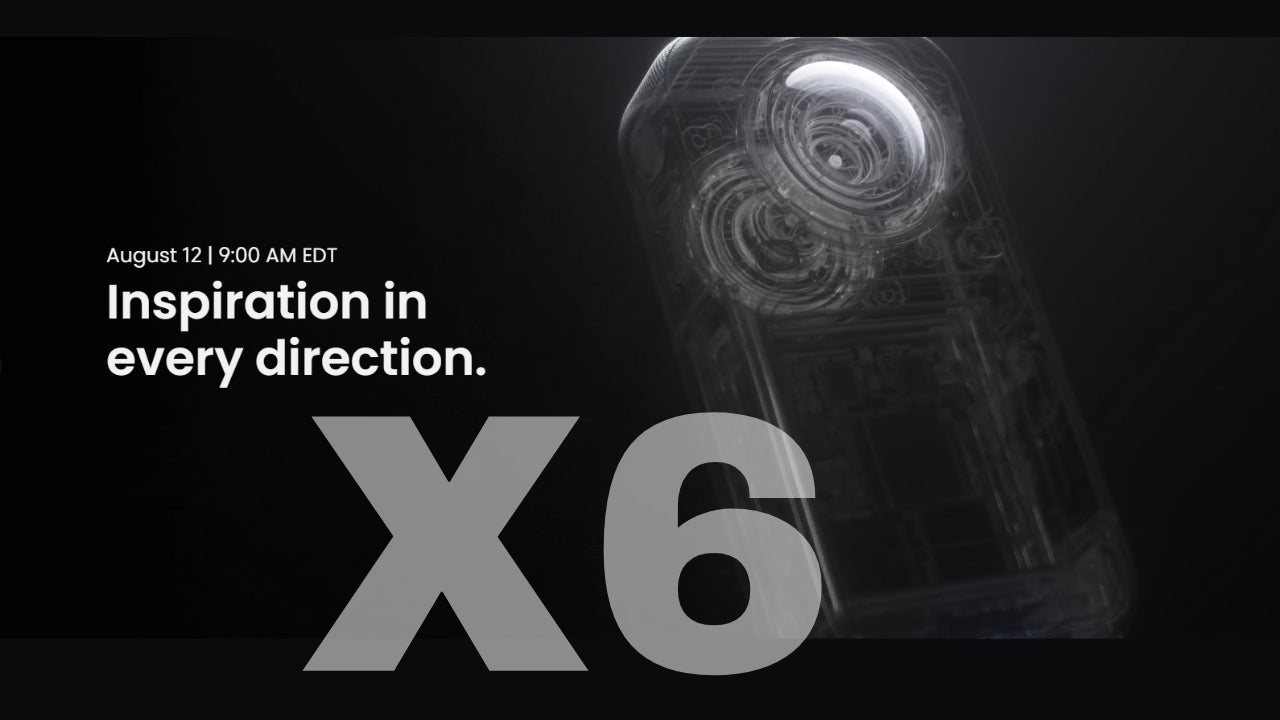
Insta360 has confirmed it: the X6 arrives August 12, 2026, at 9:00 AM EDT. The teaser campaign went live this week under the line Inspiration in Every Direction, and Insta360 describes the camera as a decade in the making.
That is a bold framing for a product in a category Insta360 has led since the original ONE X. It is also, for the first time, a product launching into real competition. DJI entered the 360 space in July 2025 with the Osmo 360, and the arrival of a second heavyweight has changed what a flagship 360 camera is expected to deliver.
We sell both brands. We have no reason to tell you one is winning. What we can do is read the announcement carefully — because there is a detail in Insta360's own wording that a lot of coverage is already reporting incorrectly.

Eight years of X-series, and what the timing tells us
Before the specs, some context that makes the rest of this easier to read.
| Model | Released | Max 360 video | The headline advance |
|---|---|---|---|
| Insta360 ONE X | October 2018 | 5.7K/30 | Established the category |
| Insta360 ONE X2 | October 2020 | 5.7K/30 | Touchscreen, waterproofing, usability |
| Insta360 X3 | September 2022 | 5.7K/30 | 1/2" sensors, larger display |
| Insta360 X4 | April 2024 | 8K/30 | The jump to 8K |
| Insta360 X5 | April 2025 | 8K/30 | 1/1.28" sensors, triple AI chip, replaceable lenses |
| Insta360 X6 | August 2026 | 8K/50 (leaked) | New custom Sony sensors, revamped AI silicon |
Read the gaps rather than the dates and a pattern appears — then breaks. Two years from the ONE X to the ONE X2. Twenty-three months to the X3. Nineteen months to the X4. Then just twelve months to the X5, the fastest turnaround in the line's history, arriving in April 2025 barely three months before DJI would enter the category.
Most trackers assumed that one-year cadence was the new normal and predicted an X6 for spring 2026. It didn't happen. Certification filings for model CINSABXA surfaced in Chinese and UAE registries back in March 2026 — the same pattern that preceded the X4 and X5 by a matter of weeks — and then nothing. April passed. So did May, June and July. FCC clearance in the United States didn't land until July 3, 2026.
The X5-to-X6 gap is sixteen months — the longest since the X3 era, and a clear reversal of the acceleration. Whatever the reason, Insta360 took its time on this one. Its own "decade in the making" framing suggests the company would rather you read that as ambition than delay. Either way, the pattern is worth knowing: this is not a routine annual refresh, and the specification set reflects that.

What Insta360 has actually confirmed
Strip the teaser down to its factual claims and you get three things.
New custom Sony sensors. This is genuinely new information and the most interesting item in the teaser. "Custom" implies a sensor built to Insta360's specification rather than pulled off Sony's catalog — which is what you would expect if the goal is a non-standard aspect ratio.
A revamped triple AI chip system. Note the verb. The X5 already runs a triple AI chip; Insta360 called it an industry first at the X5's launch. So this is a second-generation implementation, not a new architecture. Several early reports have described three chips as an X6 breakthrough. It isn't. What matters is what the revamp buys — and Insta360 hasn't said yet.
"1-inch equivalent" 8K 360 image quality. This is the line worth slowing down for.
The sensor question nobody is asking correctly
Multiple outlets are reporting that Insta360 has confirmed dual 1-inch sensors. Insta360 did not say that. It said 1-inch equivalent.
That is not a small difference, and here is why it matters: DJI uses the same construction. The Osmo 360 is marketed on "1-Inch 360° Imaging," and DJI's own footnote clarifies that when capturing 360° content, the sensor delivers an imaging area equivalent to a 1-inch sensor with a 4:3 aspect ratio. Look at DJI's technical spec sheet and the actual sensor is listed as 1/1.1-inch CMOS.
DJI isn't being dishonest. The reasoning is sound and genuinely clever. A 360 lens projects a circular image onto the sensor. On a conventional rectangular sensor, the corners outside that circle are wasted silicon. By moving to a square sensor and raising the vertical pixel count from 3,000 to 4,000, DJI captures the full image circle and reports a 25% improvement in sensor utilization. The result covers the same 360° field a traditional 1-inch sensor would — from a physically smaller part.
So when Insta360 uses the identical "equivalent" phrasing, the honest reading is that the X6 is very likely doing something structurally similar. Whether the physical sensor measures a true 1 inch, or 1/1.1-inch in a square configuration, or something else again, Insta360 has not said. Anyone telling you otherwise on August 5 is reading a marketing line as a spec sheet.
We will know on August 12. Until then, we are not going to promise you a sensor size.
Why sensor size matters more on a 360 camera than anywhere else
If the sensor debate seems like a technicality, here is the arithmetic that makes it the most important number in the camera.
A 360 camera doesn't record a picture. It records a sphere. When you edit, you reframe — you pick a window into that sphere and export a flat clip. The resolution you actually deliver is only the slice of the sphere you kept.
Work it through. 8K 360 means roughly 7,680 pixels spread across the full 360° horizontal field. Reframe to show about a third of that view — a fairly normal wide shot — and your finished clip carries around 2,560 pixels of real horizontal detail. That's approximately 2.7K. Crop tighter and it falls further.
This is the thing nobody tells you before you buy your first 360 camera: an 8K 360 camera is not an 8K camera. It is a camera that gives you 8K worth of sphere to spend, and reframing spends it fast.
Which is why sensor size is the specification that matters most here. You cannot brute-force your way out of this with resolution alone — pushing past 8K raises heat and power draw sharply, and delivers proportionally less than it costs. What actually improves the reframed image is cleaner pixels: a larger sensor gathering more light per pixel, so the slice you keep holds up in shadow, in low light, and under grading.
That is exactly where both flagships have concentrated their engineering. It is also why "1-inch equivalent" is worth pressing on rather than nodding along to.
8K50: real, and less of a leap than it sounds
Leaked retail packaging shows 8K50 on the camera's recording interface, and the figure has appeared consistently enough across independent leaks to be credible. Against the X5's 8K30 ceiling, that is a substantial jump — smoother motion, and roughly 2x slow motion on a 25fps timeline.
One correction to the coverage, though. A lot of reporting frames 8K50 as the X6 pulling ahead of DJI. It doesn't. The Osmo 360 already records 8K at up to 50fps — it is in DJI's published resolution table. So 8K50 brings Insta360 to parity, not past it. Leaks around the Osmo 360 II point to 8K60.
There is also a regional wrinkle worth knowing. 50fps is the PAL-region figure. Whether the X6 offers 8K60 for NTSC regions — which includes the United States — has not been confirmed by any leak. If you shoot primarily for phone audiences, that matters: phone displays run at 60Hz, and 50fps content can read as very slightly less fluid. It is a question we will be asking on launch day.
The upgrade that will actually change your day
The most useful number in the leak set isn't the frame rate. It's 140 minutes of continuous 8K30 recording, printed on the leaked retail box.
For context, from the official spec sheets: the X5 is rated at 93 minutes at 8K30. The Osmo 360 manages 100 minutes, or 120 with Endurance mode enabled. If 140 minutes holds up, the X6 doesn't just beat its predecessor — it beats the current class leader by a wide margin.
Anyone who has shot 8K 360 on a travel day knows why this is the headline. High-resolution 360 capture is brutal on batteries. The difference between stopping to swap cells every 90 minutes and every two-and-a-half hours is the difference between managing your gear and forgetting about it.
Replaceable Lenses 2.0
The packaging confirms a second-generation replaceable lens system. What has changed, Insta360 hasn't said — easier installation, better sealing and improved durability are all reasonable guesses, and all of them are guesses.
What we can say is that this remains one of the most underrated features in the category. 360 cameras have large, exposed, convex lenses that sit proud of the body. They get scratched. On a camera with fixed optics, a deep scratch on one lens can mean replacing the camera. The original Osmo 360 shipped with fixed lenses — and notably, leaked replacement lens kits suggest DJI is adding a user-replaceable system to the Osmo 360 II. When your competitor copies a feature, that's the strongest possible endorsement of it.

What the redesign looks like
The teaser and multiple hands-on leaks agree: the X6 is noticeably shorter and more compact than the X5 while keeping the large dual lenses. The touchscreen moves directly beneath the rear camera module, and the record button, power button, speaker and battery compartment have been relocated to the side of the body. Hands-on images also show the physical control buttons below the screen replaced by on-screen virtual controls, and a battery door that now presses to open rather than pulling.
The X-series silhouette has been tall and slender since the original ONE X in 2018. This is the biggest departure in the line's history — and it moves the X6 closer in proportion to the Osmo 360, which at 183 g is meaningfully lighter than the X5's 200 g.
X6 vs X5 vs Osmo 360
| Insta360 X6 (leaked/expected) | Insta360 X5 (confirmed) | DJI Osmo 360 (confirmed) | |
|---|---|---|---|
| Sensor | "1-inch equivalent," custom Sony — size unconfirmed | Dual 1/1.28" | Dual 1/1.1" square (1-inch equivalent field) |
| Max 360 video | 8K50 (leak) | 8K30 | 8K50 |
| Color depth | Not confirmed | 8-bit, I-Log | 10-bit, D-Log M |
| Dynamic range | Not confirmed | 13.5 stops | 13.5 stops |
| 8K30 runtime | 140 min (leak) | 93 min | 100 min (120 w/ Endurance) |
| Photo | Not confirmed | 72MP | 120MP |
| Aperture | Not confirmed | f/2.0 | f/1.9 |
| Max bitrate | Not confirmed | 180 Mbps | 170 Mbps |
| Replaceable lenses | Yes — "2.0" | Yes | No |
| Internal storage | Not confirmed | None | 105 GB usable |
| Waterproof (no case) | Not confirmed | 15 m | 10 m (IP68) |
| Weight | Not confirmed | 200 g | 183 g |
| Low-light mode | PureVideo | PureVideo | SuperNight |
Two things stand out. The Osmo 360 leads on color depth, photo resolution and internal storage. The X5 leads on waterproof depth, lens serviceability and — marginally — bitrate. The X6's job is to close the first gap without giving up the second, and until August 12 most of that column is honestly blank.
Should you wait, or buy the X5 now?
Wait for the X6 if you shoot in low light, need long continuous recording, or care about 10-bit color for grading. Every leaked upgrade points at exactly those three weaknesses. It's one week.
Buy the X5 now if you need a camera this month, or if you shoot mostly in good light where the sensor gap matters least. The X5 is a mature, proven camera with the deepest waterproof rating in its class and a full accessory ecosystem — and outgoing flagships typically see their best pricing right after a successor lands.
Consider the Osmo 360 if internal storage and 10-bit D-Log M matter more to you than replaceable lenses.
One honest note on waiting in general: a camera you own is worth more than a camera you're researching. The X5 remains a genuinely excellent 360 camera the day after the X6 launches. If you've been circling this category for months, the cost of another delay is real footage you didn't shoot. That said — the launch is one week out. This particular wait is short.
Why buy from JANGYAO
We are a Shenzhen-based operation with more than a decade in the drone and action camera supply chain, and we sell directly to US customers. That means three things for you.
Authentic, factory-sealed product. Every unit is sourced through official channels. The 360 category has a counterfeit and gray-market problem, particularly around launch windows when demand outruns supply — if a price looks impossible, it usually is.
All-inclusive US pricing. The price you see is what you pay. No surprise duties, no customs invoice after delivery.
The X6 launches August 12 at 9:00 AM EDT. We will update this article with confirmed specifications within hours of the announcement — including whether that sensor is a true 1-inch.
FAQ
When is the Insta360 X6 release date? Insta360 has confirmed August 12, 2026, at 9:00 AM EDT for the official launch event. Retail availability usually follows within days of an Insta360 announcement, though Insta360 has not confirmed a shipping date.
How long has it been since the Insta360 X5? Sixteen months. The X5 launched April 22, 2025. That is the longest gap in the X series since the X3 era, and a reversal of the trend — the X4-to-X5 gap was only twelve months.
When did each Insta360 X-series camera come out? Insta360 ONE X in October 2018, ONE X2 in October 2020, X3 in September 2022, X4 in April 2024, X5 in April 2025, and the X6 launching August 12, 2026. Release intervals ran 24, 23, 19, 12 and 16 months respectively.
Does the Insta360 X6 have a 1-inch sensor? Not confirmed. Insta360's teaser says "1-inch equivalent," which is an imaging-area claim rather than a stated physical sensor size. DJI uses identical language for the Osmo 360, whose sensor is physically 1/1.1-inch in a square configuration. The X6's actual sensor dimensions have not been published.
What is the difference between a 1-inch sensor and a 1-inch equivalent sensor? A 1-inch sensor is a physical measurement. "1-inch equivalent" means the usable imaging area for 360° capture matches what a 1-inch sensor would deliver, typically achieved with a square sensor that wastes less area outside the circular image a 360 lens projects. The equivalent part can be physically smaller while covering the same field.
Why does reframing a 360 video reduce the resolution? A 360 camera records a full sphere, and 8K describes the whole sphere rather than your finished clip. When you reframe, you export only the portion of that sphere you selected. Keep roughly a third of the horizontal view from an 8K 360 file and the delivered clip carries around 2,560 pixels of real detail — approximately 2.7K. This is why sensor quality matters more than headline resolution on a 360 camera.
Does the Insta360 X6 record 8K60? Unconfirmed. Leaks consistently show 8K50, which is the PAL-region figure. No leak has addressed whether an 8K60 mode exists for NTSC regions including the US. This should be clarified at launch.
How much better is the X6 battery life than the X5? Leaked retail packaging claims 140 minutes of continuous 8K30 recording. The X5 is officially rated at 93 minutes at 8K30. If accurate, that is roughly 50% more recording time.
Is the Insta360 X6 better than the DJI Osmo 360? Too early to say. On confirmed specs, the Osmo 360 leads on color depth (10-bit with D-Log M), photo resolution (120MP) and internal storage (105 GB). The X6's advantages appear to be battery life and replaceable lenses. Most X6 specifications remain unpublished.
How much will the Insta360 X6 cost? Insta360 has not announced pricing. European retail leaks have circulated but no US pricing has been confirmed. We will list live pricing on our product page as soon as it is official.
Should I buy the Insta360 X5 now or wait for the X6? If you shoot in low light or need long recording sessions, wait — the launch is days away and every leaked upgrade targets those areas. If you need a camera immediately or shoot mostly in good light, the X5 remains excellent, and outgoing flagships typically reach their best pricing shortly after a successor arrives.
Will the Insta360 X6 be available in the United States? The X6 cleared FCC certification on July 3, 2026, under model code CINSABXA, which is the regulatory step required for legal import and sale of RF equipment in the US. Insta360 has not published regional availability. We will confirm on launch day.
What is PureVideo mode? PureVideo is Insta360's low-light shooting mode, using AI noise reduction and dynamic range optimization. It is not new to the X6 — it already exists on the X5. Its appearance as a headline feature on the X6 packaging suggests a meaningfully improved version.
Are the X6's lenses replaceable? Leaked packaging confirms "Replaceable Lenses 2.0," a second generation of the user-replaceable lens system introduced on the X5. Insta360 has not detailed what has changed.