Industry News · JANGYAO
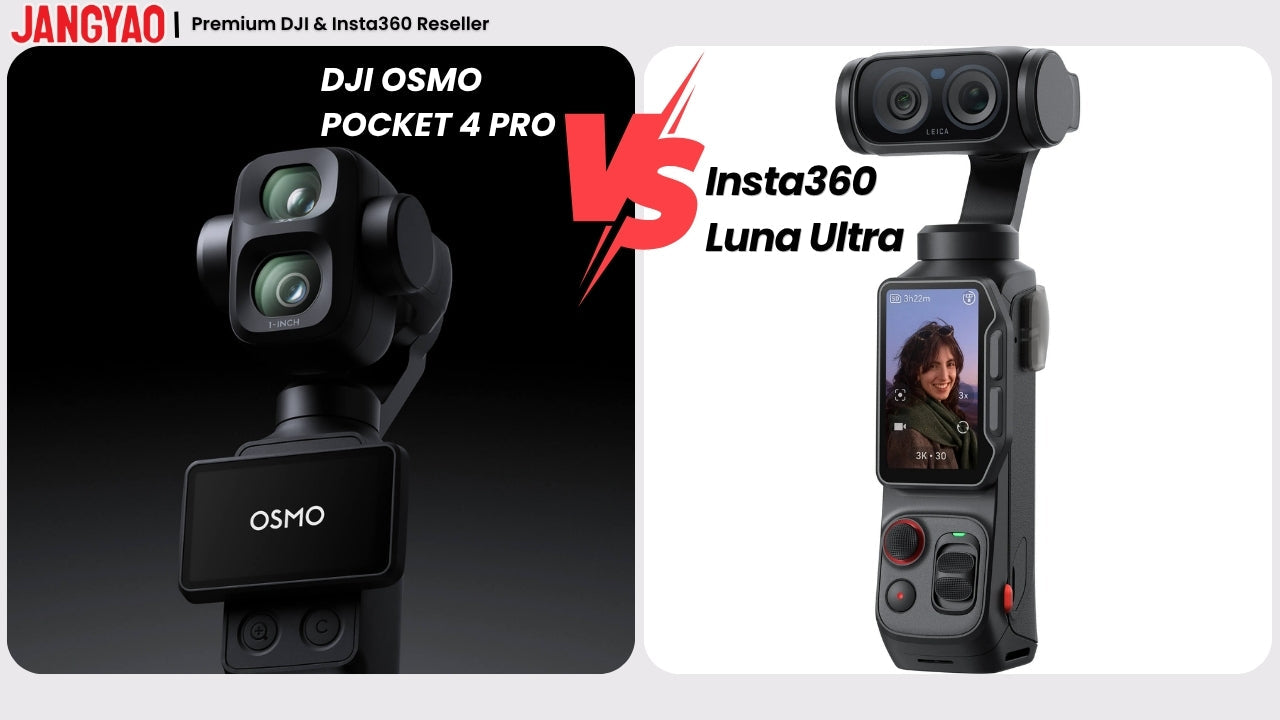
For almost three years, the pocket gimbal camera was a category DJI owned outright. The Osmo Pocket 3 defined it, the Pocket 4 refined it, and no rival came close. That era is ending. Within days of each other, two flagship dual-camera pocket gimbals are arriving — the DJI Osmo Pocket 4P (also marketed as the Pocket 4 Pro) and the Insta360 Luna Ultra — and for the first time, DJI has a genuine fight on its hands.
Both cameras finally add the one thing every Pocket owner has wished for: a real telephoto lens. But if you're shopping from the United States, there's a twist that matters more than any spec on the box — because of where the two companies stand with U.S. regulators, one of these cameras is easy to buy right now and the other is not. Here's the honest breakdown: what's confirmed, what's still rumor, how the two compare, and what it all means for an American creator.
A note on timing: as of June 2026, neither camera has fully rolled out worldwide, and several details below come from hands-on unboxings, retailer listings, and reported launch dates rather than final, official spec sheets. We've flagged what's confirmed versus what's still unconfirmed, and we'll update this article as official information lands.
Why this launch matters
The Pocket 3 didn't just sell well — it created a market. It proved that a 1-inch sensor on a tiny mechanical gimbal could replace a much bigger camera for vlogging, travel, and B-roll. The Pocket 4 polished that formula in April 2026. But through all of it, the cameras shared one real limitation: a single fixed wide-angle lens and no true optical zoom.
The Pocket 4P and the Luna Ultra both break that ceiling with a second, telephoto camera — and they do it with two very different philosophies. DJI is leaning into the image: cinema-grade color, dynamic range, and the polish of four generations of refinement, signalled by its decision to reveal the 4P at the Cannes Film Festival. Insta360 is leaning into workflow and features: a modular, creator-first design built to remove friction, headlined by a screen that pops off the camera. One is chasing the most beautiful picture; the other is chasing the most flexible shooting experience.
Meet the contenders
DJI Osmo Pocket 4P. DJI's fourth-generation Pocket and the first with a dual-camera module: a 1-inch main sensor (~20mm equivalent) paired with a dedicated 3× optical telephoto (~70mm equivalent) for true optical reach and flattering, compressed portraits. It records 10-bit D-Log2 with Hasselblad-tuned color, keeps DJI's proven 3-axis gimbal and ActiveTrack 7.0, and includes 107GB of built-in storage so there's no card to manage. A June 2 unboxing confirmed the hardware, including a magnetic fill light bundled in the Standard Combo. It stays pocketable at around 190g, and DJI offers an optional accessory called FrameTap for remote viewing. (U.S. availability is the catch — more on that below.)
Insta360 Luna Ultra. Insta360's first true pocket gimbal — and a bold one. It carries two Leica-engineered lenses (a 1-inch main sensor at f/1.8 plus a 1/1.3-inch telephoto), shoots up to 8K30 with Dolby Vision and 4K120 slow motion, and records 10-bit I-Log with built-in Leica color profiles. Its signature trick is the detachable 2-inch OLED touchscreen: it pops off and becomes a wireless remote (with live view to about 65 feet) that even has a built-in microphone. It's rated for up to four hours of battery life.
The spec face-off
| DJI Osmo Pocket 4P | Insta360 Luna Ultra | |
|---|---|---|
| Generation | DJI's 4th-gen Pocket | Insta360's 1st pocket gimbal |
| Cameras | Dual: 1″ main (~20mm) + 3× optical telephoto (~70mm) | Dual: 1″ main (~20mm, f/1.8) + 1/1.3″ telephoto |
| Color science | Hasselblad-tuned, 10-bit D-Log2 | Leica-tuned, 10-bit I-Log + Leica profiles |
| Max video | Reported up to 6K; 4K/240 slow-mo | Up to 8K30; 4K/120 slow-mo; 4K60 PureVideo |
| Dynamic range | ~14 stops (leaks suggest higher — unconfirmed) | Up to 14 stops |
| HDR / Dolby Vision | Unconfirmed | Yes — 8K30 Dolby Vision (confirmed) |
| Zoom reach | 3× optical | Up to 6× lossless / 12× maximum |
| Detachable screen | No (optional FrameTap accessory) | Yes — 2″ OLED detaches as a wireless remote (~65 ft) with built-in mic |
| Built-in storage | 107 GB | Card-based (no large built-in storage) |
| Stabilization | 3-axis mechanical + ActiveTrack 7.0 | 3-axis mechanical + FlowState + AI tracking |
| Audio | 4-channel OsmoAudio; direct DJI Mic 2 / Mic 3 | Built-in mic array + detachable-screen mic; Mic Pro support |
| Battery | Rated for several hours (real-world less) | Rated up to ~4 hr (real-world less) |
| Weight | ~190 g | Comparable, compact |
| U.S. availability | Restricted — see below | Available now |
Confirmed specs drawn from retailer listings and hands-on unboxings; items marked "reported," "leaks suggest," or "unconfirmed" are not yet officially confirmed by the manufacturers.
The differences that actually matter
Zoom and telephoto — the headline both share. This is the upgrade that finally fixes the Pocket's biggest weakness. The 4P offers a clean 3× optical reach (~70mm), ideal for portraits with natural background separation. The Luna Ultra goes further on paper — up to 6× lossless and 12× maximum — thanks to its higher-resolution telephoto sensor. If raw reach is what you want, the Luna wins the number. Whether the 4P's tighter, optically-driven approach delivers a cleaner image at its native focal lengths is the kind of thing real-world testing will settle.
Color science — Hasselblad vs Leica. One of the cleanest contrasts in the whole matchup. DJI tunes the 4P's color with Hasselblad; Insta360 tunes the Luna Ultra with Leica. Two legendary imaging names, two different "looks." Neither is objectively better — it comes down to which rendering you prefer. If you already shoot DJI, the D-Log2 pipeline will feel familiar and grade consistently with your existing footage.
The detachable screen — the Luna's signature move. This is the feature everyone is talking about, and it's genuinely clever. Pop the screen off the Luna Ultra and you have a wireless remote with a live view from a distance — set the camera down, step into frame, and check your composition from your hand without pulling out your phone. It even doubles as a microphone. For anyone who films themselves a lot, that's a real workflow upgrade. DJI's answer is the optional FrameTap accessory and the Mimo phone app — functional, but not the same one-second convenience.
Storage — the 4P's quiet advantage. The 4P ships with 107GB of built-in storage, so you can shoot all day and dump footage fast with no card to lose, corrupt, or fill mid-shoot. The Luna Ultra relies on a memory card. Not glamorous, but anyone who's had an SD card die mid-trip knows how much it matters.
Resolution and HDR. The Luna Ultra leads on paper with confirmed 8K30 and Dolby Vision capture. The 4P is reported to top out around 6K, and its HDR support is unconfirmed. For most creators delivering to YouTube, Instagram, and TikTok, 4K is still the practical ceiling — but the Luna's headroom is real.
Stabilization, tracking, and the maturity gap. This is the most important performance caveat, and nearly every reviewer raises it. The 4P is DJI's fourth pocket gimbal — four generations of refining stabilization, tracking, autofocus, and color into something that just works. The Luna Ultra is Insta360's first camera in this form factor. First-generation hardware, however impressive on paper, almost always ships with rough edges that get smoothed out over the following year of firmware updates. Insta360 is excellent at updates, and the Luna clearly learned from watching the Pocket succeed — but "version one versus version four" is a real consideration.
Ecosystem. DJI's accessory and microphone lineup (Mic 2, Mic 3, filters, handles) is deep and mature. The Luna's accessory range will take time for the market to fill out, as it does with any new platform.
What the reviewers are saying
The early consensus splits along predictable lines. For image quality and reliability, reviewers lean toward the Pocket 4P — its color, dynamic range, and DJI's track record make it the "safe, cinematic" pick, especially for creators chasing a filmic look. As one put it, the 4P feels like the more refined, professional tool the moment you sit down to edit.
For innovation and self-filming workflows, the excitement is all about the Luna Ultra. The detachable screen-and-mic is described as the single most creative feature in the category right now, and the telephoto reach plus 8K headroom make it the spec champion. The recurring caution is simply that it's a first-generation product going up against a fourth-generation one.
The honest summary most reviewers reach: there's no single "best" pocket gimbal here — there's the right one for how you shoot. If you film yourself often and value flexibility, the Luna's detachable screen is the reason to look. If you shoot mostly handheld and care most about the image and a proven workflow, the 4P is the safer call — if you can get one.
The U.S. reality: what you can actually buy right now
This is where American buyers need to pay close attention, because the playing field is not level — and it has nothing to do with the cameras themselves.
In December 2025, DJI was added to the FCC Covered List. The short version: after a federally mandated national-security review of DJI went uncompleted by its deadline, the FCC moved to block new foreign-made drones — and, in DJI's reading, its broader communications and imaging equipment — from receiving the FCC authorization required to be legally imported, marketed, and sold in the United States. DJI is challenging the decision in court, and as of mid-2026 the matter is still unresolved.
What that means in plain terms:
- It does not ban owning or using DJI gear. Any DJI product already in the U.S. and previously authorized — including the Osmo Pocket 3 — remains legal to own, use, and buy from existing stock.
- It does restrict brand-new DJI products. A camera as new as the Pocket 4P can't move through the normal FCC authorization path, so it is not available through standard U.S. retail. Imported "gray-market" units may surface from third-party sellers, but those can lack U.S. authorization, warranty, and support — something to weigh carefully before buying one.
- It does not affect Insta360. The Luna Ultra isn't a DJI product and isn't on the Covered List. It's launching and selling in the U.S. normally — which is a big part of why so many American creators are looking at it.
So for a U.S. buyer in 2026, the practical reality is almost the inverse of the spec sheet. On paper, this is a close fight. In your shopping cart, the Luna Ultra is the one you can actually click "buy" on today, while the Pocket 4P sits behind a regulatory wall that may or may not come down. If you're set on a DJI Pocket experience right now, the still-excellent Pocket 3 — fully authorized and available — is the realistic choice.
Buying authentic gear from JANGYAO
Whichever camera fits your work, the same two questions apply to any cross-border purchase: is it genuine, and what will I actually pay by the time it reaches my door? Those questions got sharper in 2025, when the U.S. ended duty-free de minimis treatment — meaning packages from overseas now clear customs and can carry duties they didn't before. Surprise fees on delivery are a real risk if you buy from a seller who isn't transparent about it.
JANGYAO exists to take that uncertainty off the table for U.S. creators:
- 100% authentic, factory-sealed. Sourced through official channels — no gray-market substitutions. What you order is exactly what left the factory.
- All-inclusive pricing — no surprise fees at delivery. Import duties are handled up front and built into the price you see, so the number at checkout is the number you pay. (We'll always be straight about what is and isn't included.)
- In-house DJI repair expertise. With over a decade of hands-on experience with DJI hardware, JANGYAO can service drones directly — a real advantage in a moment when replacing DJI gear in the U.S. is harder than it used to be. (Repair expertise centers on DJI drones; cameras and other categories follow the manufacturer's standard warranty process.)
- Competitive pricing on the gear you can get. Including the Insta360 Luna Ultra and authorized DJI products like the Osmo Pocket 3, plus the accessories that round out your kit.
If you're not sure which camera — or which generation — fits your style of shooting, reach out before you buy. We'd rather help you make the right call than sell you the wrong thing.
Should you buy now, or wait?
Be honest with yourself about what you need. If the detachable self-filming screen or true telephoto reach would genuinely change how you work, the Luna Ultra is available today and delivers both — just remember it's a first-generation camera, so expect firmware to keep maturing over its first year.
If you mostly shoot handheld vlogs, travel, and everyday content, the Pocket 3 still does almost everything these new cameras do, costs less, is available now, and carries none of the first-generation risk. And if your heart is set on the Pocket 4P specifically, the realistic move for a U.S. buyer is to watch how DJI's FCC case unfolds rather than chase an unauthorized import — we'll update this page as the situation changes.
The bottom line
The pocket gimbal category just went from a one-horse race to its most exciting moment in years. The Pocket 4P is shaping up to be the image-first, cinematic, reliable choice — DJI doing what DJI does best, now with a real telephoto — but in the U.S., it's caught behind a regulatory wall. The Luna Ultra is the bold, feature-rich, creator-first challenger, led by a detachable screen that genuinely rethinks how you shoot yourself, and it's the one American buyers can actually get right now.
We'll publish a full hands-on comparison once both cameras are in wide circulation. Until then, if you're weighing your options — or want to know which one suits your style of shooting — reach out. We're happy to help you make the right call before you spend.