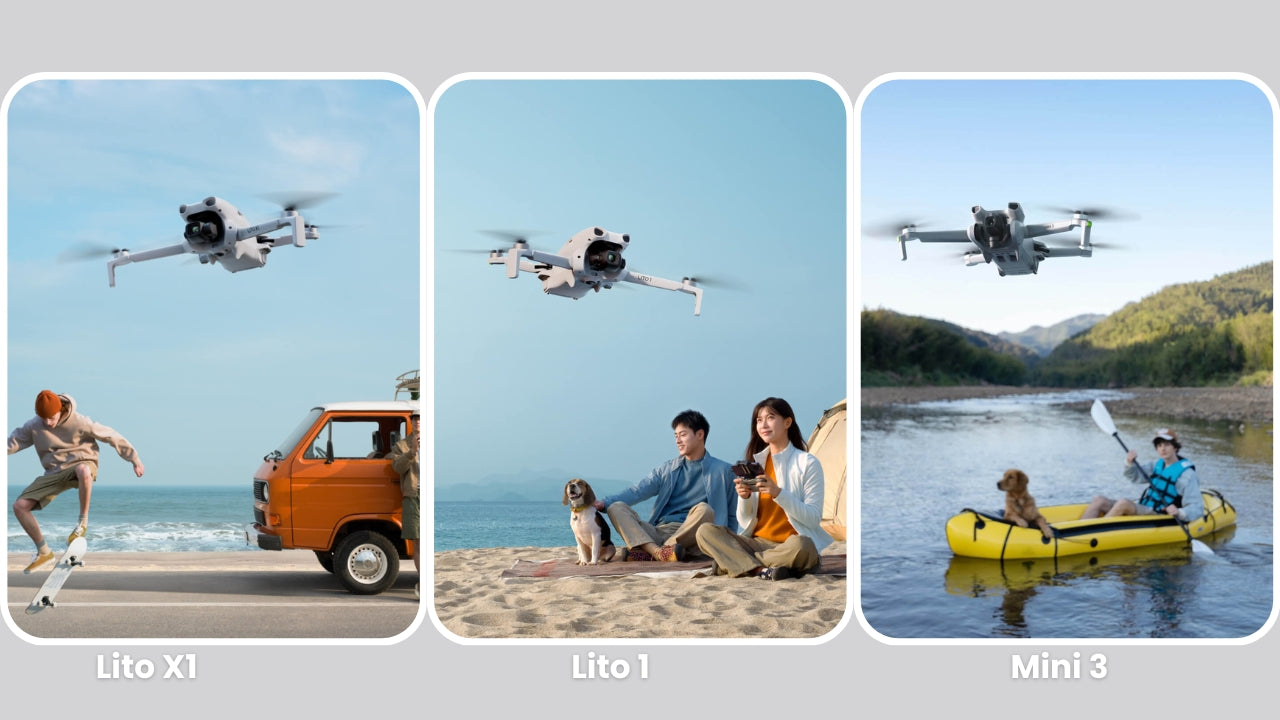
If you've spent any time researching your first drone, you've seen this exact matchup: the DJI Lito X1 against the Lito 1 against the Mini 3. The reviews are everywhere, and most of them are glowing.
There's one fact almost none of those reviews mention — because most were filmed in Canada, the UK, or Europe. If you're buying in the United States, you can't purchase the Lito X1 or the Lito 1 at all. Not from DJI, not from a US retailer, not from anyone selling legally.
So let's do this honestly. We'll explain what's going on, walk through the full comparison anyway so you know exactly what you're weighing, and then show you what actually makes sense to buy in the US right now. Because the real question for an American buyer in 2026 isn't "Lito X1 or Mini 3" — it's "what can I actually get, and does the Mini 3 still hold up?"
Spoiler: it does.
The part global reviews skip: why you can't buy the Litos in the US
On December 23, 2025, the FCC added DJI — along with all other foreign-made drones — to its national-security "Covered List." The practical effect is narrow but important: new foreign-made drone models can no longer receive the FCC equipment authorization they need to be legally imported, marketed, or sold in the US.
Two things this rule does not do, because the confusion around it is enormous:
It does not ground the drone you already own. Any DJI drone that was FCC-authorized before December 23, 2025 remains fully legal to buy, own, fly, and sell. There are no recalls and no remote shut-offs. It also does not change FAA flight rules for existing drones.
What it does do is freeze new arrivals. The DJI Lito 1 and Lito X1 launched on April 23, 2026 — four months after the cutoff. Their US authorization is still pending, and DJI has confirmed the Lito series will not be available in the US market. That's the whole story: not a delayed shipment, but a regulatory wall.
Could it change? Possibly. DJI is challenging the decision in court, and the FCC has signaled that future models could still be cleared through the Department of Homeland Security or the Department of Defense. But as of today, there is no US path to a Lito. We'll update this guide if that shifts.
None of that makes the comparison useless — it makes it clarifying. Knowing what the Litos offer is exactly how you judge whether the drone you can buy leaves anything important on the table.
The comparison anyway: here's what the Litos bring
| DJI Lito 1 | DJI Lito X1 | DJI Mini 3 | |
|---|---|---|---|
| US availability (mid-2026) | Not available | Not available | Available |
| Weight | Under 249 g | Under 249 g | Under 249 g |
| Sensor | 1/2" CMOS | 1/1.3" CMOS | 1/1.3" CMOS |
| Aperture | f/1.8 | f/1.7 | f/1.7 |
| Photo | 12 MP (48 MP mode) | 12 MP (48 MP mode) | 12 MP + RAW |
| Max video | 4K/60 | 4K/60 HDR, 14 stops | 4K/30 HDR |
| Slow motion | 4K/100 | 4K/100 | 1080p/60 |
| Color depth | 8-bit, standard | 10-bit D-Log M | 8-bit |
| True vertical (rotating gimbal) | No — 2.7K crop | No — 2.7K crop | Yes — 4K vertical |
| Obstacle sensing | Omnidirectional | Omnidirectional + front LiDAR | Downward only |
| ActiveTrack | Yes | Yes | No |
| MasterShots / Hyperlapse | Yes | Yes | No |
| Transmission | DJI O4, 15 km | DJI O4, 15 km | DJI O2, 10 km |
| Internal storage | None | 42 GB | None |
| Flight time (std / Plus) | 36 / 52 min | 36 / 52 min | 38 / 51 min |
Three differences would actually have mattered to a first-time buyer:
Obstacle sensing. The Mini 3 sees only downward. Both Litos add sensors in every direction, and the X1 adds a forward LiDAR for low-light and complex environments. Since most beginner crashes happen flying sideways — exactly where the Mini 3 is blind — this is the Litos' clearest advantage. Worth one caveat every experienced pilot repeats: obstacle sensing is an aid, not a guarantee. Thin wires, power lines, and bare branches still defeat it.
Color depth. The Lito X1 records 10-bit D-Log M; the Mini 3 records 8-bit. That's the difference between footage that's ready to post and footage that's ready to grade. If you plan to learn color work, it's the single most meaningful line in the table.
Vertical video — and here the Mini 3 wins. The Mini 3's gimbal physically rotates and shoots true 4K vertical with no crop. Both Litos fake it with a digital crop that tops out at 2.7K. For anyone shooting Reels or TikTok first, the older Mini 3 does something neither newer drone can.
So the Litos would have been a real step forward on sensing and color — while the Mini 3 quietly keeps the one feature social-first creators care about most.
The 48 MP myth, so you don't overpay for it later
Both Litos advertise a 48-megapixel photo mode, and you'll see the same spec on plenty of drones you can buy. Here's what a professional drone photographer found after testing both Litos: no meaningful detail gain between the 12 MP and 48 MP files — just much larger files, at the cost of dynamic range that's already limited on sensors this size. He reports the same pattern across every quad-bayer drone he's tested, and notes that simply upscaling the 12 MP file in editing sometimes looks better.
We mention it because it's the kind of thing a store usually stays quiet about. If a headline megapixel number is pulling you toward one drone over another, pick a better reason.
So what should a US buyer actually get?
The DJI Mini 3 is the one drone in this comparison you can buy in the US — and it has aged remarkably well. Sub-250 g, a genuinely good 1/1.3-inch sensor, true vertical shooting, and a price that has dropped well below its launch cost. For most first-time American buyers, it remains one of the best entry points into the hobby, Lito or no Lito.
Want more sensing and 10-bit color? The natural step up that's actually available in the US is the DJI Mini 4 Pro. It was authorized long before the December ban, and it brings the omnidirectional obstacle sensing, ActiveTrack, 4K/60 HDR, and 10-bit recording that the Mini 3 lacks. Confirm current stock when you buy — it's popular and moves quickly.
One honest warning. Don't go hunting for the DJI Mini 5 Pro in the US. Despite being DJI's newest sub-250 g flagship, it was never properly released on DJI's US store, reportedly over a customs issue, and its US availability is unreliable at best. If you land on a site calling itself something like "DJI USA" and showing the Mini 5 Pro in stock, be careful — that is not DJI's official US store, and the post-ban market is exactly where gray-market and counterfeit listings multiply.
Prefer a non-DJI route? Sub-250 g alternatives like the Autel EVO Nano+ are US-available and offer obstacle avoidance in a lightweight body. They're the main option if you want DJI-style features from a different brand.
Why buying authentic matters more now than ever
Here's the uncomfortable truth about a market where new DJI drones can't be imported: it gets messy fast. Gray-market sellers move in. Fake "official" storefronts appear. Authenticity, warranty, and real support stop being fine print and start being the whole decision.
That's where JANGYAO comes in.
100% authentic, sourced through official channels. Every DJI and Insta360 product we sell is the real thing — never gray-market, never counterfeit, never a substitution. In a post-ban US market, that guarantee is the point.
Competitive, all-inclusive US pricing. The price you see is the price you pay. No surprise fees waiting for you at delivery.
In-house DJI repair expertise. Our team has over a decade of hands-on experience with DJI hardware. When a drone needs service, you reach real technicians — not a chatbot, not a script. As new DJI models get harder to source in the US, that repair knowledge becomes one of the most valuable things a specialist can offer.
US customer support. Real people, answering real questions, before and after you buy.
We'd rather point you to the right drone than push you toward the most expensive one — and right now, for most US beginners, the right drone is a Mini 3 or a Mini 4 Pro, bought authentic.
The bottom line
The DJI Lito X1 and Lito 1 are excellent beginner drones — for buyers outside the United States. Inside the US, they're off the table for now, and no amount of spec-sheet enthusiasm changes that.
The good news is that the drone you can actually buy, the Mini 3, is still one of the best first drones on the market, and it holds the one feature — true vertical video — that even the newer Litos can't match. If you want obstacle sensing and 10-bit color, step up to the Mini 4 Pro. Either way, buy authentic, and be cautious of any US listing that looks too good to be true.
Not sure which one fits how you shoot? Reach out — we're glad to help you get it right before you spend.