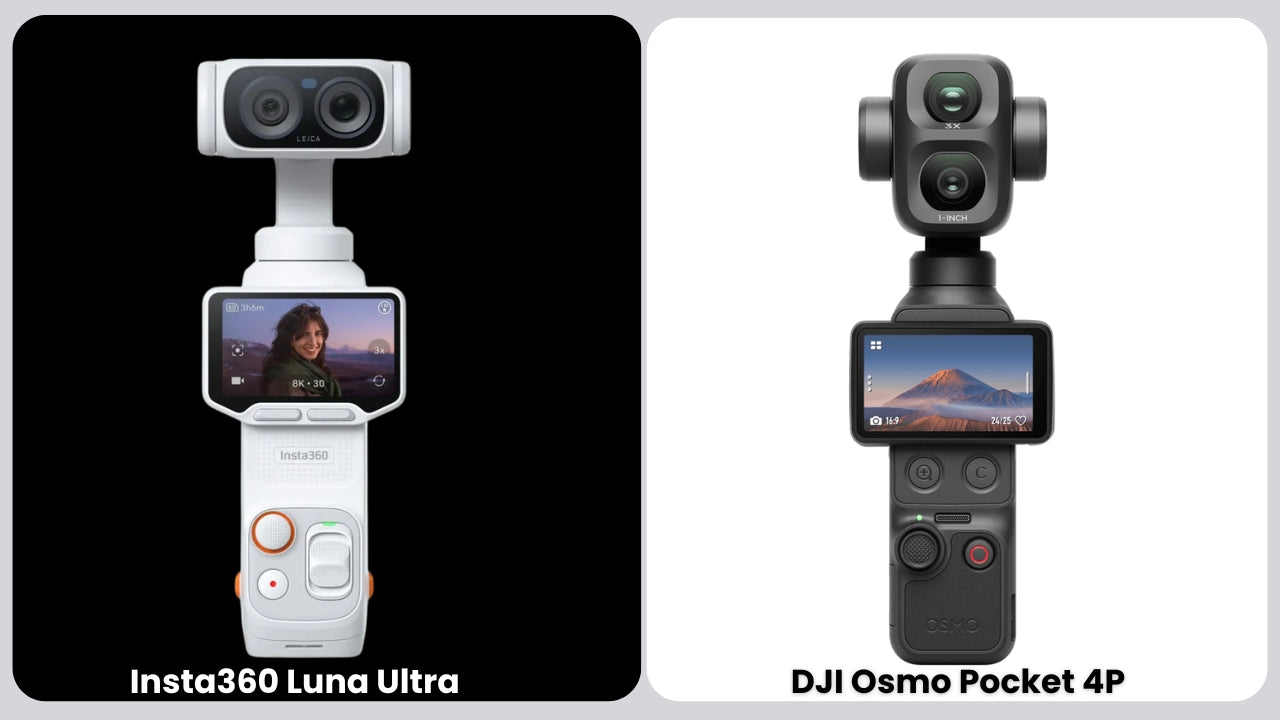
When both cameras were still speculation earlier this year, the comparisons circulating online were built on spec sheets, marketing footage, and educated guesses. Anyone confidently declaring a winner was making a bet, not a verdict.
That's over. Both cameras are now officially shipping. Multiple independent reviewers have tested them side by side in real-world conditions, without NDA restrictions. The picture has clarified — and it's more interesting than either brand's marketing suggested.
This is the head-to-head, post-launch verdict. What each camera actually does well, what each one still gets wrong, and how to decide which one fits your work.
An editorial note before we start
JANGYAO carries both cameras. That should make what follows easier to trust — we don't have a house-brand agenda in this comparison. If the Pocket 4P is right for you, that's the sale. If the Luna Ultra is right for you, that's the sale. Our job here is to help you land on the right camera, not the more expensive one.
The U.S. context — what matters before you shop
One piece of context matters more than any single spec: the DJI Osmo Pocket 4P is not sold through standard U.S. retail. It isn't currently FCC-approved for domestic distribution. The Insta360 Luna Ultra, by contrast, is available through Insta360's normal U.S. sales channels.
This changes how you buy the Pocket 4P, but it doesn't lock U.S. creators out. JANGYAO ships authentic Pocket 4Ps directly from Shenzhen to U.S. addresses with import duties included at checkout — no tariff surprise on delivery. Because we source both cameras direct from manufacturer, our pricing on the Luna Ultra is also often more competitive than major U.S. retailers, even though the Luna is domestically available.
With that out of the way, here's the actual comparison.
Where the DJI Osmo Pocket 4P wins
The main sensor is the real story
The Pocket 4P's headline advantage isn't the second lens — it's the first one. DJI put a brand-new 1-inch OmniVision LOFIC sensor into the main camera and paired it with a new D-Log2 profile that reaches approximately 17 stops of dynamic range. That's a number cinema cameras deliver. It's not the number a pocket gimbal usually plays in.
In systematic backlit tests, the Pocket 4P holds sky detail cleanly in scenes where the Luna Ultra washes out. Shooting into direct sunlight, golden hour with high contrast, interior scenes with bright windows — the Pocket 4P has headroom the Luna doesn't. If you grade every clip, that headroom becomes real editorial flexibility.
One honest caveat: D-Log2 only works on the wide lens at 1× zoom. Zoom into the 3× telephoto and the camera drops back to standard D-Log. It's a workflow interruption DJI should close in firmware.
Color that grades faster
Reviewers consistently prefer DJI's out-of-camera color over Luna's. The Luna Ultra tends toward oversaturation and can pick up a pink tint in certain skin-tone scenes; DJI renders more neutrally. If you don't grade every clip, DJI gives you a starting point closer to what you'll deliver.
Storage that lasts a full shoot
The Pocket 4P ships with 103 GB of internal storage. The Luna Ultra ships with 47 GB. On a long shoot day, that's the difference between "keep rolling" and "swap cards." For travel creators without a laptop for daily offloading, this is a genuine practical win.
The DJI ecosystem
If you already own a DJI drone, use DJI Mic 2 or Mic 3, and process footage in DJI Mimo, the Pocket 4P slots into your workflow with zero friction. Time codes sync. Color science matches. Battery grip and gimbal-mount accessories carry over. This is the mature-tool argument, and for professionals shooting client work, it matters.
Small wins that add up
The fill light draws power from the camera battery — no separate accessory to remember to charge. The Pocket 4P also supports motionlapse and slow-shutter creative modes; the Luna doesn't have these yet, though firmware could add them.
Where the Insta360 Luna Ultra wins
The detachable screen changes solo shooting
The Luna Ultra's screen is not a separate accessory — it's part of the camera, and it detaches. You can set the camera on a tripod, walk into frame, and monitor your shot from your palm. There's an unusual editorial consensus on this: every reviewer we sourced called this the single most important feature separating the Luna from the Pocket 4P.
DJI's answer is the Frame Tap remote, an adapted phone-gimbal accessory that ships with the Creator Combo. It's a separate device with a 3:2 screen (black bars in 16:9), a separate charging dongle, and connection stability reviewers flagged as weaker than expected — even at close distances. It's not equivalent, and it wasn't designed for this camera from the ground up.
Tracking that actually keeps up
This is the surprise finding of the post-launch cycle, and it deserves attention: the Pocket 4P's Active Track 8.0 tests worse than the Pocket 4's Active Track 7.0 in some occlusion scenarios. In one systematic fountain test, both the Pocket 4 and the Luna Ultra re-acquired the subject after brief occlusion; the Pocket 4P did not. At 12× zoom, in low light, tracking through foliage and street traffic — the Luna kept up in tests where the Pocket 4P lost the subject entirely.
If your work depends on tracking — solo vlogging while moving, action content, kids or pets — this is a real advantage.
Telephoto that works with your log workflow
The Pocket 4P's 3× telephoto can shoot 4K/200fps, but only in the standard color profile. Try to shoot slow motion on the 3× in D-Log, and you can't. The Luna Ultra's 3× shoots up to 4K/120fps in I-log, which means your slow-mo integrates cleanly with the rest of your graded footage. Frame rate is lower; workflow is more usable.
Macro and close focus
The Luna's 3× telephoto has a 13 cm minimum focus distance. The Pocket 4P's telephoto is 17 cm. For product photography, food, beauty, or any workflow involving close-up detail, Luna gets closer and holds sharper detail.
Interface and daily-use polish
Both custom buttons on the Luna are user-programmable (only one on the Pocket 4P). The buttons stay accessible in vertical mode on the Luna (the Pocket 4P's are covered when the screen flips). Luna records native 4K vertical by rotating the entire camera 90°, with proper orientation metadata written to the file — the Pocket 4P caps at 3K vertical. The on-screen zoom slider on the Luna is smooth and continuous; the DJI joystick has to choose between gimbal control and zoom control. Menu animations are noticeably cleaner on the Luna.
Small wins that add up
A hard protective case is included in every Luna Ultra box; the Pocket 4P ships with only a plastic gimbal clip (a regression from the Pocket 3's proper case). Luna's Leica-tuned filter presets for stills received strong marks from reviewers. The Mic Pro in the Luna Creator Combo offers 32-bit float internal recording. And Insta360's head-tracker accessory — an in-ear device that makes the camera follow where you look — is genuinely unique to the Luna ecosystem.
The honest caveats — both cameras have them
Every reviewer's biggest complaint about the Luna Ultra: the auto-ISO "mush" problem. In specific auto-exposure configurations, the camera uses digital gain to hit the target exposure, then applies heavy noise reduction to clean up the resulting noise — which destroys fine detail in the process. You don't see it until you offload the footage. Insta360 has publicly acknowledged the issue and committed to a firmware fix. Check Insta360's release notes for the latest status before you buy. The workaround in the meantime: shoot manual ISO for full control.
Every reviewer's biggest complaint about the Pocket 4P: the Frame Tap remote is not equivalent to Luna's detachable screen. It's a separately purchased device, adapted from a phone gimbal, with a 3:2 screen aspect, a separate charging dongle, and inconsistent signal even at close range. If remote monitoring is central to your workflow, this is the real gap. Active Track 8.0's tracking regression is also on DJI to address in firmware.
Neither camera is a bad buy. Both have identifiable, specific limitations. The right question is which limitations you can live with.
Quick comparison table
| DJI Osmo Pocket 4P | Insta360 Luna Ultra | |
|---|---|---|
| Main sensor | 1" LOFIC CMOS (new OmniVision) | 1" CMOS |
| Telephoto sensor | 1/1.28" 37 MP | Smaller than main |
| Focal lengths | 20 mm f/2.0 + 60 mm f/1.8 | ~15 mm equiv + 3× tele |
| Max dynamic range (main) | ~17 stops (D-Log2) | ~14 stops (I-log) |
| Pro color profiles | D-Log + D-Log2 exclusive | I-log (10-bit) |
| Max video (main) | 4K/240fps (normal profile) | 4K/120fps (I-log capable) |
| Max video (telephoto) | 4K/200fps (normal only) | 4K/120fps (I-log capable) |
| Native photo resolution | 37 MP | 37 MP + native 4:3 mode |
| Internal storage | 103 GB | 47 GB |
| Continuous 4K/60 recording | ~1h 58min (before shutdown) | ~1h 20min (thermal throttle) |
| Vertical video | 3K max | 4K (rotate camera) |
| Custom buttons | 1 (covered in vertical mode) | 2 (always accessible) |
| Screen / remote | Frame Tap (separate accessory) | Detachable screen (integrated) |
| Included case | Plastic gimbal clip | Hard protective case |
| Fill light power | Camera battery | Separately charged |
| Creator Combo microphone | DJI Mic 3 | Insta360 Mic Pro (32-bit float) |
| U.S. retail availability | Restricted (cross-border via JANGYAO) | Yes (domestic + JANGYAO) |
Specifications from independent reviewer testing and manufacturer materials. Subject to final firmware and manufacturer confirmation.
Which one is right for you?
The strongest way to make this decision isn't to score the specs — it's to name how you shoot. Here's the honest persona map:
🎬 You're an established DJI creator with a Mic 3 and DJI Mimo already in your workflow. → Pocket 4P. Everything you own already fits.
📹 You're building a solo creator kit and want the most intuitive experience. → Luna Ultra. The detachable screen alone justifies it.
📸 You shoot client work — weddings, events, corporate content. → Pocket 4P. Dynamic range headroom and color consistency are worth the cross-border route.
🌍 You're a travel creator who values quick, easy, in-stock buying. → Luna Ultra. Domestic U.S. availability keeps things simple.
🎨 You color grade every clip and need maximum dynamic range. → Pocket 4P. D-Log2's 17 stops on the main lens is not marketing hype in real backlit scenes.
🍔 You shoot product, food, or beauty content close-up. → Luna Ultra. 13 cm macro on the 3× telephoto wins clearly.
📱 You produce for TikTok, Reels, and vertical short-form. → Luna Ultra. Native 4K vertical with proper metadata is a real workflow win.
🏃 You film subjects that move — kids, pets, action content. → Luna Ultra. Tracking is the more forgiving system.
Why buy from JANGYAO
JANGYAO is a Shenzhen-based specialist focused on getting authentic DJI and Insta360 hardware to U.S. creators without the friction.
✅ Original, factory-sealed product. Sourced through official manufacturer channels. No gray-market substitutions, no refurbs sold as new.
✅ All-in U.S. landed pricing. Import duties and shipping are calculated and included at checkout. The price you see is what you pay.
✅ Both cameras in stock. We carry the full DJI Osmo Pocket lineup and the Insta360 Luna Ultra, plus the current accessory ecosystems for both brands.
✅ Fast tracked shipping. Typical delivery window of 7–14 business days to most U.S. addresses, with end-to-end tracking.
✅ U.S. checkout. Stripe, Shop Pay, PayPal, Apple Pay, Google Pay, and all major credit cards. No currency conversion fees.
✅ English customer support. Real humans, real 24-hour response window during business days.
✅ 12-month original warranty on both cameras against manufacturing defects.
⚠️ Scam alert: JANGYAO never requests additional tax payment by SMS or WhatsApp. If you receive that kind of message, ignore it — your order is paid in full at checkout.
→ [JANGYAO shipping & duties policy]
Frequently asked questions
Is the DJI Pocket 4P sold in the U.S.?
Not through standard U.S. retail. The Pocket 4P isn't currently FCC-approved for domestic distribution. JANGYAO ships authentic Pocket 4Ps directly from Shenzhen to U.S. addresses with duties included at checkout.
Is the Insta360 Luna Ultra available in the U.S.?
Yes, through Insta360's normal U.S. retail channels. JANGYAO also carries the Luna Ultra, typically at more competitive pricing since we source direct from manufacturer.
Can I use my DJI Mic 3 with the Luna Ultra?
No. DJI's audio ecosystem (Mic 2, Mic 3) works with DJI cameras. Insta360's Mic Pro works with the Luna Ultra. These are closed ecosystems — one microphone won't cross brands.
Which camera arrives at my address faster?
The Insta360 Luna Ultra typically ships faster from U.S. domestic warehouses. The Pocket 4P via JANGYAO ships from Shenzhen with a 7–14 business day window to most U.S. addresses, tracked end-to-end.
Has the Luna Ultra "mush" issue been fixed?
Insta360 has publicly acknowledged the auto-ISO issue and committed to a firmware fix. Check Insta360's release notes for the current status before purchase. In the meantime, shooting in manual ISO produces clean footage.
Which one is better for vertical short-form (TikTok, Reels)?
Luna Ultra. Native 4K vertical recording with proper metadata makes it the cleaner workflow for short-form platforms. The Pocket 4P caps at 3K vertical.
Which one is better for client and professional work?
Pocket 4P. The mature DJI ecosystem, class-leading dynamic range on the main sensor, and cleaner color science make it the safer tool when consistency matters most.
Do JANGYAO's U.S. prices include tariffs?
Yes. All listed U.S. prices are landed cost — import duties calculated at checkout and included in the total. No separate duty invoice on delivery.
What about warranty on each?
Both cameras carry a 12-month JANGYAO warranty against manufacturing defects. For service, our process follows manufacturer standards — you contact us, we evaluate, we coordinate repair or replacement.
Can I buy the Pocket 4P and the Luna Ultra bundled?
They aren't sold as a bundle. But because JANGYAO stocks both, some creators buying to test at scale ask us about combined orders — reach out through our customer support if that's your situation.
The honest bottom line
Neither camera wins objectively — both have real strengths and real limitations. The right pick is the one that fits how you actually work, not the one that scores marginally higher on any single spec.
If the DJI Mic already in your kit and D-Log2's dynamic range matter more than the detachable screen, you want the Pocket 4P. If the detachable screen, better tracking, closer macro, and cleaner vertical workflow matter more than 17 stops of grading room, you want the Luna Ultra.
If you want a second opinion on your specific use case before committing, reach out. Whether the answer is DJI or Insta360, we're stocked either way — and we'd rather help you pick the right camera than sell you the more expensive one.
→ [Shop the full DJI pocket gimbal camera lineup at JANGYAO]