If you've spent any time researching the DJI Osmo Pocket 4P, you already know there's a problem. The camera launched in China in June 2026. It's been featured in Toronto and Cancun creator events. There's Chinese-market marketing footage circulating. And U.S. creators have been quietly asking the same question for weeks: how do I actually buy this thing?
This guide answers two questions at once. First — among the three current-generation DJI Pocket cameras (Pocket 3, Pocket 4, and Pocket 4P), which one is the right pick for the way you actually shoot? Second — what do U.S. buyers specifically need to know about availability, tariffs, and warranty, before clicking "buy"?
No hype. No marketing copy. Just a straight read on each camera, including where the newest one falls short, where the older ones still win, and where U.S. realities change the math.
The U.S. context — the part most reviews skip
Here's what's true as of June 2026, and what most "Pocket 4P review" videos awkwardly dance around:
- The DJI Osmo Pocket 4P is not approved for U.S. retail by the FCC. It will not be sold by B&H, Adorama, Best Buy, or Amazon's U.S. storefront.
- The Pocket 4 is similarly restricted from the standard U.S. retail channel. Some inventory exists through gray channels, but the official path is closed.
- The Pocket 3 is still cleanly available in the U.S. via authorized retail.
- U.S. tariffs on imported electronics from China have continued to rise through 2025–2026, which means any cross-border purchase carries duty exposure — unless the seller is absorbing it.
That's the playing field. It's why a U.S.-based reviewer who's already living with the Insta360 Luna correctly noted he can talk freely about the Pocket 4P only because he wasn't invited to a DJI NDA event — and why he keeps reminding viewers that the camera "is not going to be available in the U.S." in any conventional sense.
That doesn't mean U.S. creators are locked out. It means the path is direct cross-border purchase from a specialist — exactly what JANGYAO is built for. Original DJI hardware, sourced through official factory channels in Shenzhen, with U.S. duties and shipping included in the price you see. No tariff surprises at the door, no "extra fees on delivery" voicemail from FedEx. The price is the price.
With that out of the way, let's get into the actual cameras.
The quick lineup
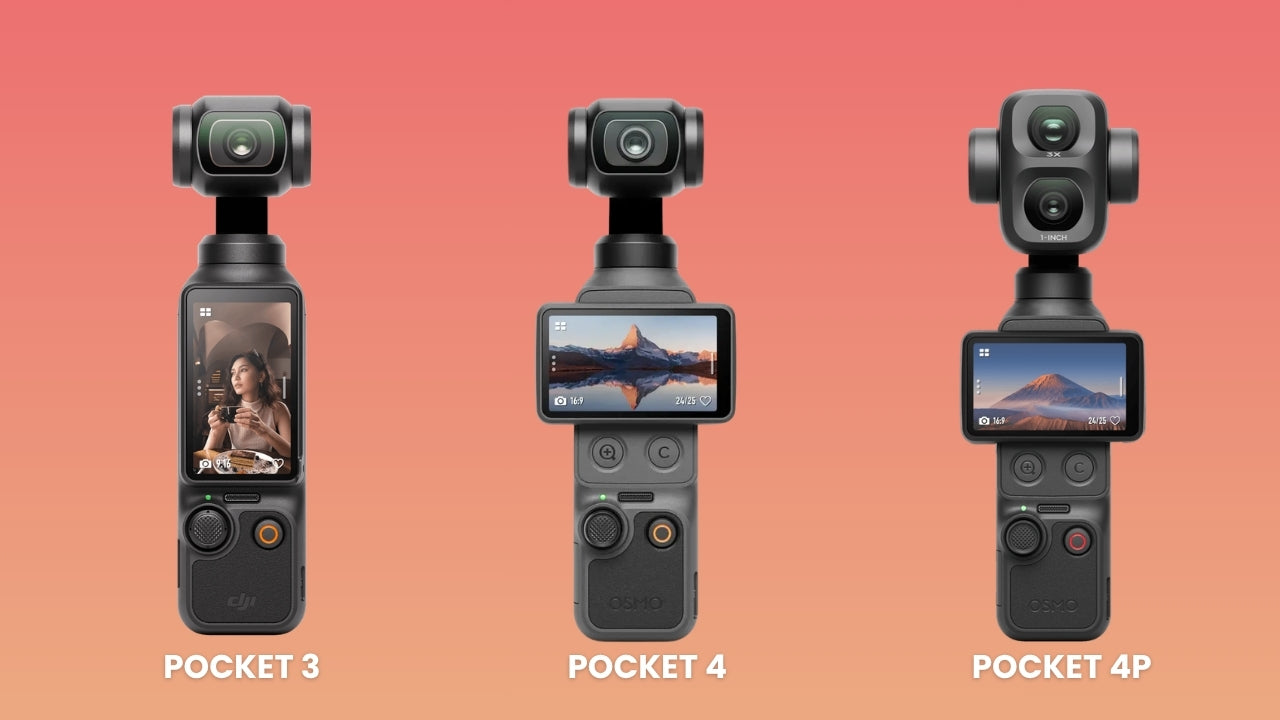
- Pocket 3 (2023) — The camera that proved a 1-inch sensor and a mechanical 3-axis gimbal could fit in your palm. Still in production. Still excellent. Still the only one of the three with a clean U.S. retail path.
- Pocket 4 (April 2026) — The incremental refinement of the Pocket 3. Real upgrades in storage, slow-motion, physical controls, and low-light. Not a revolution.
- Pocket 4P (June 2026) — The first Pocket with two lenses. Adds a 60 mm telephoto and debuts a new main sensor with LOFIC technology and an exclusive D-Log2 color profile.
Three cameras, three philosophies. Let's open each one.
Pocket 3 — why it still makes sense in 2026
The most honest thing you can say about the Pocket 3 is what one U.S.-based creator — whose channel was literally built around this camera — said before the Pocket 4 launched: he was fully ready to upgrade on day one, and after watching the early reviews, he genuinely wasn't sure it was worth it.
The reason is simple. The Pocket 3 already delivers the full category package:
- 1-inch sensor, 4K recording, roughly 12.7 stops of dynamic range
- D-Log M with DJI's official LUT for flexible grading
- 3-axis mechanical stabilization that still beats any phone you can buy
- Reliable ActiveTrack for real-world subject following
- An internal mic that's above the category average
In good light — daylight, exteriors, well-lit interiors — the Pocket 3 produces footage that's nearly indistinguishable from the Pocket 4 in side-by-side tests. Some reviewers even prefer its more contrasted, more saturated look at default settings.
Pocket 3 is the right pick if:
- You want maximum value and the safest U.S. availability story
- You shoot mostly in natural light — travel, exteriors, daytime vlogs
- You're already comfortable with the D-Log M workflow and don't want to redo your color pipeline
- You prefer the lightest, most compact body in the lineup
The Pocket 3's real weakness shows up in low light. Dark interiors, night scenes, mixed-light environments — that's where the Pocket 4 and 4P open visible distance.
→ [Shop DJI Osmo Pocket 3 at JANGYAO]
Pocket 4 — the incremental, but real upgrade
The Pocket 4 is, more than anything, a better-finished Pocket 3. It's not a revolution. More than one U.S. reviewer made the same point: at a glance, the two cameras are hard to tell apart. Look closely, and use it every day, and the improvements add up.
What actually changed:
-
107 GB of built-in storage — roughly three hours of 4K/24fps with no SD card. Forget your card, still record. For travel-heavy creators, that's a real insurance policy.
-
Two new physical buttons — a dedicated zoom button (1×, 2×, 4× without touching the screen) and a custom button (flip camera, recenter gimbal, lock gimbal). More than one reviewer flagged the custom button as the upgrade that improves their daily workflow the most — more than any spec gain.
-
Full D-Log (not just D-Log M) — wider latitude, better highlight and shadow retention, flatter base for grading. A real technical step for anyone who color grades.
-
4K/240fps slow motion — the Pocket 3 capped at 240fps only at 1080p; the Pocket 4 holds 4K at that frame rate.
-
37 MP photos with RAW support — the Pocket 3 was stuck at 9 MP JPEG-only. For a video-first camera that doubles as your travel stills camera, this is a significant upgrade.
-
Noticeably better low-light performance — brighter image, less noise, more shadow detail. This is the one area where the Pocket 4 is clearly ahead of the 3.
-
ActiveTrack 7.0 — smoother subject following, quicker recovery when the subject passes behind an obstacle.
-
Longer battery in the body — independent testing puts the Pocket 4 around 3h 30min continuous at 4K/24fps, versus ~2h 15min on the Pocket 3.
What didn't change: vertical resolution still capped at 3K (a real miss for short-form creators), no open-gate mode, and the internal mic is essentially the same.
Pocket 4 is the right pick if:
- You want the most current-gen feature set without paying for the dual-lens setup
- You shoot in mixed light or interiors regularly
- You color grade and want full D-Log
- You use slow motion as a recurring storytelling tool
The U.S. catch on the Pocket 4: official retail availability is restricted. The same cross-border path that delivers the 4P delivers the 4 — and JANGYAO handles both.
→ [Shop DJI Osmo Pocket 4 at JANGYAO]
Pocket 4P — the upgrade built for creators
The Pocket 4P is the most talked-about pocket camera of 2026, and also the most misread. The quick takeaway says, "Now it has a telephoto." The honest read from technical reviewers says something else entirely.
The surprise nobody saw coming: two new sensors
DJI could have kept the Pocket 4's main sensor and just bolted on a telephoto lens. Most observers expected that. Instead, DJI dropped two completely new sensors into the 4P:
- The main lens (20 mm equivalent, f/2.0) — same focal length as the Pocket 4, but with a brand-new 1-inch LOFIC sensor. In practical terms, this sensor handles high-contrast scenes in a way no camera this small has handled before.
- The telephoto lens (60 mm equivalent, f/1.8) — a 1/1.28-inch, 37 MP sensor. Basic image quality is in the same neighborhood as a high-end phone's main camera.
This is the detail U.S. creators benchmarking against the Insta360 Luna keep missing: the 4P isn't trying to match Luna's spec sheet. It's trying to be a better main camera with a useful secondary lens, not the other way around.
The D-Log2 profile — exclusive to the 4P
This is the spec the product page doesn't push hard enough. The Pocket 4P ships with D-Log2, a color profile that isn't available on DJI's professional cameras. With D-Log2 enabled, the 4P reaches roughly 17 stops of dynamic range on the main lens — a number that puts it in the same territory as cinema cameras for highlight and shadow retention.
Independent technical testing has shown scenes where standard D-Log clips the highlights, and switching to D-Log2 brings the detail right back. For U.S. creators chasing the Insta360 Luna's 14-stop dynamic range as their reference point, the 4P's 17 stops is the spec that genuinely justifies the comparison.
The 60 mm telephoto — honestly evaluated
The 60 mm is a real game-changer for some shooters and a small disappointment for others:
- Where it shines: portraits. 60 mm is a classic focal length for filming people — natural, close to how the human eye sees. The f/1.8 aperture produces real background separation, the kind of cinematic presence wide-angle cameras simply can't deliver.
- Minimum focus distance of just 30 cm (about 12 inches). That's unusual. You can hold something in your hand — a coffee cup, a product, a phone — and shoot it cleanly with natural blur. For food, beauty, and product creators, that single feature can justify the price step.
- Where it falls short: from longer distances, the telephoto softens noticeably compared to the main sensor. It's very good for close-range work and acceptable for casual use. It is not a replacement for an interchangeable-lens telephoto.
The wireless screen remote (Frame Tap) — the secret weapon
The Pocket 4P's Creator Combo includes a separately-housed wireless touchscreen viewfinder remote, sold as the Frame Tap. It mirrors the camera's feed, controls the gimbal and zoom remotely, and lets you start and stop recording from your hand. Testing puts the stable connection range at up to 100 meters in open environments.
For solo creators — anyone who films themselves without an operator — this is the accessory that genuinely changes what you can shoot. Set the camera down, walk into frame, adjust composition from your palm, capture a third-person shot without compromise. It's not as elegant as the Insta360 Luna's directly-detachable screen, but it's functionally similar, and the camera's onboard screen stays available.
What didn't change
This is the part that needs saying clearly: below the gimbal head, the Pocket 4P is essentially a Pocket 4. Same battery (1,545 mAh), same stick form factor, same compatibility with most Pocket 4 accessories including the magnetic fill light. The 4P is roughly 40 g heavier — you feel it, but it doesn't change daily use.
Pocket 4P is the right pick if:
- You film people — portraits, interviews, close-up creator content
- You're a solo vlogger who wants the Frame Tap remote
- You shoot high-contrast environments (golden hour, interiors with windows) and want D-Log2's headroom
- You run small productions and want a second focal length without adding a second camera
- You produce food, beauty, or product content and benefit from the 30 cm minimum focus
→ [ Shop DJI Osmo Pocket 4P at JANGYAO]
Quick comparison table
| Pocket 3 | Pocket 4 | Pocket 4P | |
|---|---|---|---|
| Lens(es) | 20 mm f/2.0 (single) | 20 mm f/2.0 (single) | 20 mm f/2.0 + 60 mm f/1.8 |
| Main sensor | 1" CMOS | 1" CMOS | 1" CMOS with LOFIC |
| Telephoto sensor | — | — | 1/1.28" 37 MP |
| Dynamic range (main) | ~12.7 stops | ~14 stops (D-Log) | ~17 stops (D-Log2) |
| Pro color profile | D-Log M | D-Log | D-Log + D-Log2 (exclusive) |
| Max video | 4K/120fps | 4K/240fps | 4K/240fps |
| Photo | 9 MP, JPEG | 37 MP, JPEG + RAW | 37 MP, JPEG + RAW |
| Internal storage | — | 107 GB | 103 GB |
| Battery (body) | ~2h 15min | ~3h 30min | ~3h |
| Physical buttons | — | Zoom + Custom | Zoom + Custom |
| Wireless screen remote | — | — | Yes (Creator Combo) |
| Approx. weight | ~179 g | ~190 g | ~230 g |
| U.S. retail availability | Yes | Restricted | Restricted |
| Best for | Travel, vlog, first camera | Modern first buy, low light | Creators, portraits, small teams |
Specifications based on independent testing and DJI's technical materials. Subject to final manufacturer confirmation.
Which one is right for you?
Instead of declaring a single winner, here's the simpler question: how do you actually shoot?
🎒 "I shoot travel and vlog content mostly in natural light." → Pocket 3. You won't miss the Pocket 4's upgrades. You'll feel the lighter body and the friendlier price. Cleanest U.S. availability story.
🎥 "I'm buying my first Pocket camera in 2026 and want the modern feature set, but I don't need a telephoto." → Pocket 4. The storage, button, low-light, and tracking refinements are worth the step over the Pocket 3 — without the dual-lens premium of the 4P.
🎬 "I film people, shoot product content, or work in small production teams." → Pocket 4P. The 60 mm telephoto, the exclusive D-Log2, and the wireless screen remote will become parts of your daily kit. The premium is justified.
🎙️ "I already own a Pocket 3 and I'm wondering if I should upgrade." → Honestly, the Pocket 4 alone may not justify the move. More than one creator who lives with the Pocket 3 came to the same conclusion before the 4P existed. If you're going to upgrade, the case for the 4P is stronger — telephoto, D-Log2, and the remote together change what you can shoot, not just how it looks.
Why buy from JANGYAO
JANGYAO is a Shenzhen-based specialist focused on a narrow mission: getting authentic DJI and Insta360 hardware to U.S. creators without the friction.
✅ Original, factory-sealed product. Sourced through official manufacturer channels in Shenzhen. No gray-market substitutions, no refurbs sold as new.
✅ All-in U.S. landed pricing. Import duties and shipping are calculated and included at checkout. The price you see is the price you pay. No tariff surprises on delivery.
✅ Decade-deep DJI expertise. Our team has worked with DJI hardware since 2017 — supply chain, technical, and post-sale.
✅ U.S. dollar pricing, U.S. checkout. Stripe, Shop Pay, PayPal, Apple Pay, Google Pay, and major credit cards. No currency conversion fees.
✅ Fast cross-border shipping. Tracked end-to-end from our Shenzhen warehouse. Typical delivery window 7–14 business days to U.S. addresses.
✅ Email and chat support in English. Real humans, real responses within 24 hours business days. We're based in China, so the time zone may add a few hours — but every message is read and answered.
✅ Transparent warranty handling. Every product carries a 12-month JANGYAO warranty against manufacturing defects, plus our cross-border RMA process for the rare case something needs service.
⚠️ Scam alert: JANGYAO will never request additional tax payment by SMS, by text message, or via WhatsApp links. If you receive a message like that, ignore it — your order is already paid in full at checkout.
→ [ JANGYAO shipping & duties policy]
Frequently asked questions
Is the DJI Pocket 4P sold in the U.S.?
Not through standard U.S. retail. The Pocket 4P is not currently FCC-approved for U.S. retail distribution. U.S. creators can still get the camera through direct cross-border purchase — which is exactly what JANGYAO offers, with U.S. import duties included in the listed price.
What about tariffs and import duties?
Already included. JANGYAO's listed prices for U.S. orders are landed-cost prices — meaning U.S. import duties on Chinese electronics are calculated and absorbed at checkout. You won't get a separate duty invoice on delivery.
Is the Pocket 3 still worth buying in 2026?
Absolutely. For natural-light shooters — travel, exteriors, daytime vlogs — the Pocket 3 delivers roughly 90% of what the Pocket 4 delivers, in a lighter body, at a more accessible price, with the cleanest U.S. availability story.
Should I pay extra for the Pocket 4P if I'm not a professional creator?
Honestly, in most cases, no. The telephoto, the D-Log2 profile, and the Frame Tap remote are upgrades built for creators who film people, product, or work in small production setups. For casual vlogging and travel, the Pocket 4 covers the use case with margin.
Are accessories cross-compatible across the three Pockets?
Most Pocket 4 accessories (fill light, mini tripod, DJI Mic 2 / Mic 3) also work with the Pocket 4P. The Pocket 4P introduced a new detachable lens-cover system that accepts ND and wide-angle filter elements. Pocket 3 accessories don't always transfer to the newer generations — check the product page before buying standalone accessories.
How does the JANGYAO warranty work?
All cameras carry a 12-month JANGYAO warranty against manufacturing defects. For Pocket-series service specifically, our process follows manufacturer standards — you contact us, we evaluate the case, and we coordinate repair or replacement. Full process and timelines on our [link: warranty page].
How long does shipping to the U.S. take?
Typical delivery is 7–14 business days from order confirmation to your U.S. address, with end-to-end tracking. We ship from our Shenzhen warehouse via tracked express services. Delivery windows can vary slightly by region.
Will the Pocket 4P work with DJI Mic 3?
Yes. The Pocket 4P supports DJI's current mic ecosystem (Mic 2 and Mic 3 transmitters), with the same OsmoAudio four-channel workflow introduced on the Pocket 4. The Mic 3 is included in the Pocket 4P Creator Combo.
The honest bottom line
The Pocket lineup is one of the few DJI categories where three generations all still make sense in 2026. The choice isn't between "old" and "new." It's between three different cameras solving three different creator problems.
The Pocket 3 is still excellent — and the safest U.S. buy. The Pocket 4 is the refinement most users would buy without thinking if it were available everywhere. The Pocket 4P is the first Pocket that delivers something genuinely new — a real telephoto, a sensor that punches above its size, and a workflow built around solo creators.
Buy the one that fits the way you actually shoot. If you want a second opinion before you commit, reach out — we'd rather help you pick the right camera than sell you the most expensive one.
→ [Shop the full DJI Osmo Pocket lineup at JANGYAO]