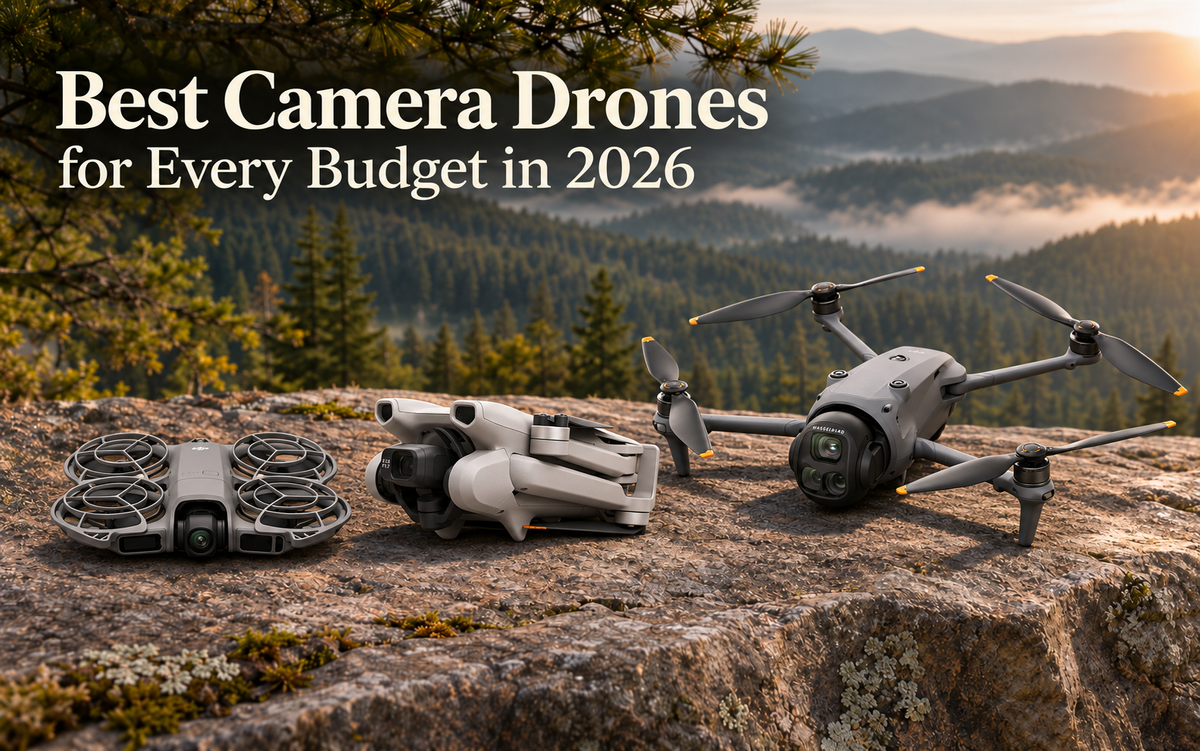
Two of our favorite camera drones under $300 cost just $10 apart, and they suit completely different people. The $269 DJI Mini 4K is the one we’d hand to someone who wants to learn to fly and frame a landscape. The $279 DJI Neo 2 is the one we’d suggest to someone who wants footage of themselves hiking that landscape. With the Mini, you’re behind the camera. With the Neo, you get to be in the shot. Compare the Mini 4K and Neo 2.
That’s how we chose the rest of this list, too. The Mini 3 is our value pick for travel photography, the Mini 5 Pro is our all-around pick under $1,000, and the Air 3S is where we’d spend more for a second lens. The Mavic 4 Pro earns its premium when you already have a shot in mind that calls for its long telephoto camera.
The quick picks
These are JANGYAO’s listed U.S. dollar prices for the specific configurations shown, checked November 6, 2026. Selecting a different controller, battery package, or aircraft-only version can change the price.
| Budget | Camera drone and kit | Best reason to buy it |
|---|---|---|
| Under $200 | DJI Neo, no remote · $189 | Take quick, hands-free clips on a tight budget. View kit |
| Under $300 | DJI Mini 4K Standard · $269 | Learn to pilot and film steady aerial landscapes. View kit |
| Under $300 | DJI Neo 2, drone only · $279 | Film yourself moving without having to work the sticks. View kit |
| $300–$499 | DJI Mini 3 with RC-N1 · $339 | Shoot travel photos and native vertical 4K video. View kit |
| $500–$999 | DJI Mini 5 Pro Standard · $839 | Get a compact travel drone with tracking, slow motion, and more room to edit color. View kit |
| $1,000–$1,999 | DJI Air 3S with RC-N3 · $1,199 | Shoot a wide establishing shot and a tighter detail from the same flight. View kit |
| $2,000 and up | DJI Mavic 4 Pro with RC 2 · $2,389 | Build a sequence around three distinct focal lengths. View kit |
Under $300: Do you want to fly the camera or be in the frame?
For learning to fly, we’d buy the Mini 4K. Imagine filming a slow reveal over a lakeshore. You want to decide when the far bank comes into view, how quickly the camera rises, and where the shot ends. The Mini 4K gives you a controller and a three-axis gimbal that keeps the camera steady as you practice. For daylight landscapes and family trips, we’d happily start here and keep the rest of the budget for another day out. DJI Mini 4K Standard
For filming yourself, we’d buy the Neo 2. Its basic kit works without a physical remote. Launch it from your palm and let it follow you or perform a preset move. In I Tried 25 Drones, the reviewer explains what changed their mind about the Neo line: they liked the original’s follow-me idea, but the Neo 2 was the first version whose footage they were happy to recommend for social posts. That’s a persuasive reason to spend the extra $90 over the original Neo if you’ll use it regularly. Watch the Neo 2 comparison
If $200 is a firm ceiling, the original Neo still makes sense for a quick clip of you and your friends at a trailhead. If what you really want is to pilot a camera slowly along that lakeshore, we’d save the extra $80 for the Mini 4K. The two purchases teach you different things. DJI Neo kit
Under $500: The DJI Mini 3 is the travel value pick
At $339 with the RC-N1 controller, the Mini 3 costs $70 more than the Mini 4K. Here’s what that buys you on vacation: when a waterfall looks better framed from top to bottom, you can turn the camera vertically and record in 4K. You keep the waterfall and the pool below it in the frame without cutting a narrow strip out of a horizontal clip. The Mini 3 also shoots RAW photos, handy when the sky and the ground need different adjustments back home. DJI Mini 3 kit · DJI Mini 3 camera details
One of the best arguments for this drone came from a reviewer who took it to Norway as a backup for an Air 3S. The Mini fit inside the larger drone’s case. The reviewer brought one battery, flew in the mountains, then plugged it into a portable charger on the walk down. If your trips usually have an hour of walking between viewpoints, you can see why a spare battery might be less urgent than it sounds at checkout. Watch the Norway field review
There are good reasons to stop here and good reasons to move up. For a daylight panorama or a vertical travel clip, we’d pocket the savings. If you want the camera to follow you around a bend, the Mini 3 lacks ActiveTrack. The reviewer also found its footage harder to work with as daylight faded and preferred the Air 3S for demanding color edits. Those are specific limits worth paying to fix if you encounter them often. See the reviewer’s examples and verdict
Under $1,000: The DJI Mini 5 Pro is the one we’d pack most often
The $839 Mini 5 Pro Standard is our pick for someone who shoots a little of everything. You can film a horizontal landscape, rotate the camera for a vertical clip, then capture a cyclist in slow motion. Its 1-inch sensor, subject tracking, and 10-bit recording give you room to take on more ambitious shoots while keeping the aircraft small enough to share a backpack with another camera. If you edit video, 10-bit recording gives you more latitude to adjust colors afterward. DJI Mini 5 Pro configurations
The revealing detail in I Tried 25 Drones is that the reviewer would keep the Mavic 4 Pro if they could own only one, yet the Mini 5 Pro is the one they reach for most often. It fits alongside their other gear, and they find it relatively quiet. Anyone who has left a good camera at home because the bag was already full will recognize that distinction. Watch the reviewer explain their everyday pick
When would we keep the $500 difference and buy the Mini 3? When most of the footage will be daylight scenery, posted with a light edit. Both cameras turn vertically. The Mini 5 Pro earns its price when you’ll also use tracking, slow motion, or the extra editing flexibility.
$1,000 to $2,000: Buy the DJI Air 3S for its second camera
Say you’re filming a lakeside cabin. The wide camera gives you the cabin, dock, and sweep of shoreline in one frame. Switch to the Air 3S’s 70mm-equivalent camera and you can frame the porch against the wooded hillside from the same position. Cut those shots together and a viewer knows both where the cabin sits and what it feels like to be there. That second shot is the strongest reason to spend $1,199 on the Air 3S. DJI Air 3S lens specifications · JANGYAO Air 3S with RC-N3
Both reviewers found a place for the Air 3S. One singled out the telephoto camera and preferred its handling in wind to the Mini 5 Pro. The other wanted its sensor and 10-bit footage for professional work, even after getting travel shots they liked from the Mini 3. If a shoot calls for a wide and a detail shot, we’d take the Air. For a long hike where the drone might come out for one overlook, we’d pack the Mini. Air 3S comparison · Mini 3 reviewer’s verdict
$2,000 and up: When the DJI Mavic 4 Pro earns its place
The $2,389 Mavic 4 Pro with RC 2 gives you three ways to frame a scene, including 70mm- and 168mm-equivalent telephoto cameras. Picture a lighthouse on a headland. A wide shot shows the curve of the coast. A 70mm view gives the lighthouse more of the frame. With the 168mm camera and a suitable viewpoint, you can line up the lantern room against a distant cliff. That last composition would be hard to get from a wide camera and a crop. DJI Mavic 4 Pro lens specifications · JANGYAO Mavic 4 Pro kit
The reviewer who picked the Mavic as their personal favorite also described what it felt like to carry on a hike. Even folded, it took up noticeably more room than a Mini. Our buying rule: look at the last few videos you made. If you kept cropping into wide shots because you wanted a distant subject larger in the frame, compare the Air 3S and Mavic telephoto samples. If your favorite clips were sweeping views, the less expensive drone may already give you the look you like. Watch the telephoto examples
Before you choose a kit
Is the Fly More Combo worth it? Think about the time between flights. A hiker can recharge on the way to the next overlook. Someone filming the exterior of a property may need three takes while the evening light is still on the front door. The second buyer has a much better reason to pay for extra batteries. See the Mini 3 reviewer’s one-battery setup
Is a controller with a screen worth the extra money? A phone-based controller is a sensible place to save. A built-in screen becomes more useful if you regularly need your phone for something else. The Norway reviewer liked having theirs free to record behind-the-scenes footage of the drone taking off. If that sounds like your workflow, a screen controller is an upgrade you’ll use from day one. Watch the controller comparison
What does “drone only” mean for a first-time buyer? Check how that particular aircraft can be operated. The Neo 2 supports palm launch and automated shots. An aircraft-only Mini listing may make sense for someone replacing a drone and reusing compatible equipment. Before ordering, check the selected version, included controller and batteries, product condition, and any activation disclosure. If you already own a controller, send JANGYAO its exact model name and the listing you’re considering so the team can help confirm the pairing. Browse JANGYAO camera drones · Ask JANGYAO about compatibility